You can pass the cosmetology state board on your first try if you study in the right order: learn the terms, practice applying them, then take timed mock exams. I'm a working hair extension stylist in Boise, and I train apprentices for this exam. This is the plan I give them.
Whether you're in beauty school or an apprenticeship, the state board is two tests: a written (theory) exam and a hands-on practical exam. Here's how to get ready for both.
Know your exam before you study for it
Most states use exams written by the National-Interstate Council of State Boards of Cosmetology (NIC). There are two parts, and you usually have to pass both.
The written (theory) exam. The NIC cosmetology theory exam has 110 multiple-choice questions, and 100 of them count toward your score. Each question has four answer choices, and you get 90 minutes. The content is weighted roughly like this:
Hair care and services: about 45%. Cutting, color, chemical texture, styling and scalp care.
Scientific concepts: about 35%. Infection control, safety, anatomy, chemistry and electricity.
Skin care and services: about 10%.
Nail care and services: about 10%.
Look at that split. Science is more than a third of the test, and it's the part most students skip because it feels less fun than hair. Don't skip it.
The practical exam. You perform timed services on a mannequin while an examiner grades your technique. They also watch your infection control and safety at every step. You can do a beautiful finger wave and still lose points for setting a dirty comb on your clean station.
Check your own state. Testing companies, fees, passing scores and what to bring all vary by state. Before you build a study plan, download your state board's candidate information bulletin and read the whole thing. In Idaho, start with the Idaho Board of Cosmetology through the Division of Occupational and Professional Licenses (DOPL).
An 8-week study plan that works
Cramming doesn't work for this test. There are too many terms, and the questions are worded to catch you if you only half know something. Here's the plan I give my apprentices.
8 weeks out
Read your state's candidate bulletin and schedule your exam date.
Take one full practice test cold. Don't study first. Your score shows you where you stand.
Write down every topic you missed. That list becomes your study map.
6 weeks out
Start with science: infection control, decontamination levels, bacteria, chemistry, pH and electricity.
Study 30 to 45 minutes a day, not three hours on Sunday.
Make flash cards for every term you can't define out loud.
4 weeks out
Move to hair: color levels and developer strength, the color wheel, cutting elevations, head regions and chemical texture.
Take a timed practice test each week and track your score.
Start practicing your practical services with a timer.
2 weeks out
Cover skin and nails: skin layers, lesions, massage movements and nail structure.
Go back to your missed-terms list and quiz yourself only on those.
Do a full practical run-through with your complete kit.
1 week out
Review, don't learn anything new.
Take your last full practice test under real test conditions.
Pack and label your practical kit.
The night before
Skim your missed-terms list one last time, then put it away.
Lay out your ID, admission letter and kit.
Go to bed early. A rested brain remembers more than a crammed one.
Study tips that make it stick
Say it out loud. If you can explain a term to someone else without looking, you know it. If you can only recognize it in a list, you don't know it yet.
Learn the why, not just the word. Don't just memorize that a level 10 is the lightest blonde. Know why you'd need a higher-volume developer to lift there. The test asks the same idea in different ways, and understanding covers all of them.
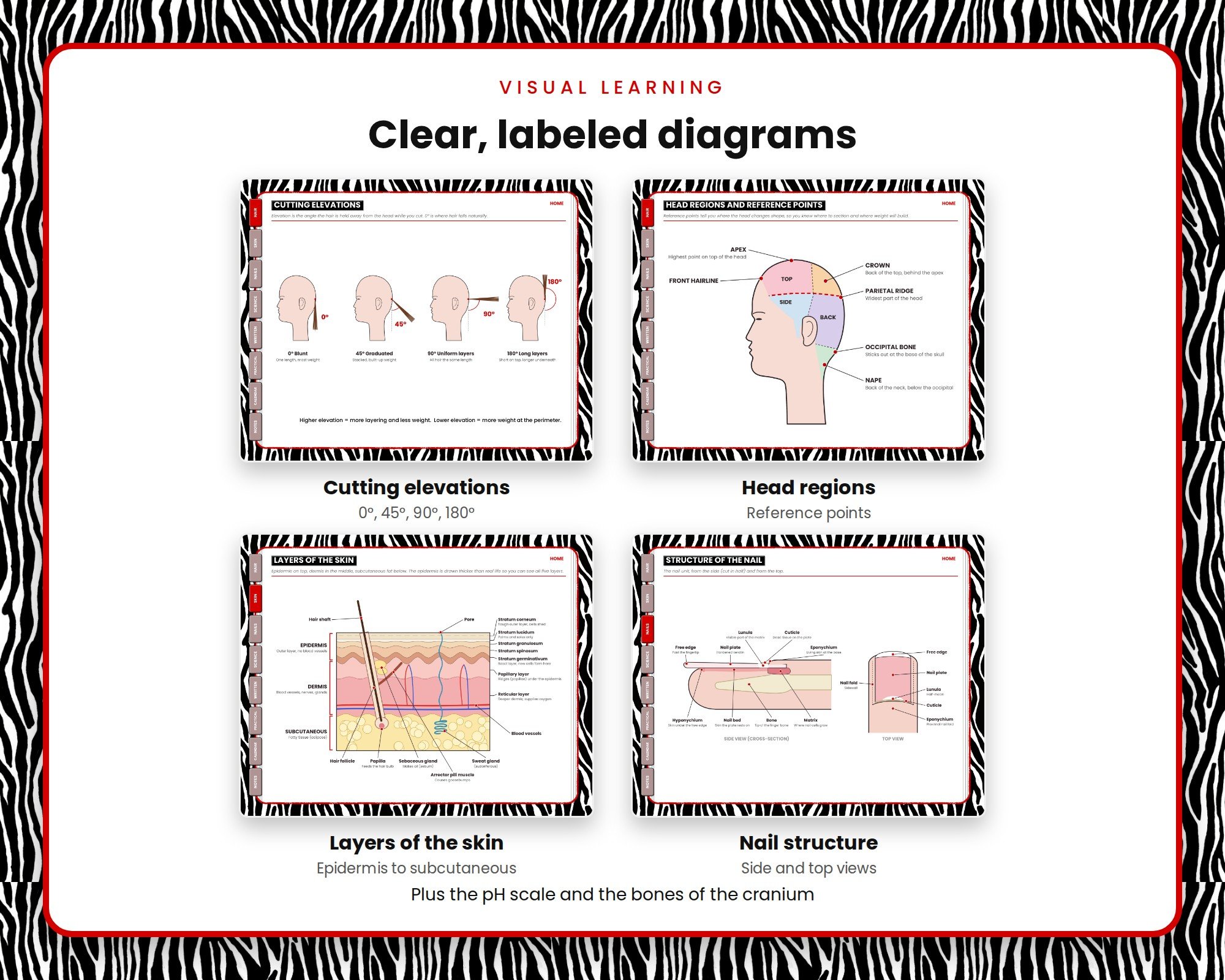
Use pictures for the visual stuff. Elevations, head regions, skin layers and nail anatomy are much easier to remember from a labeled diagram than from a paragraph. Draw them yourself from memory, then check your drawing.
Keep a missed-terms list. Every time you get a question wrong, write the term down. Review that list more than anything else. It's your personal study guide.
Practice under real conditions. Time yourself. Take practice tests in one sitting with your phone in another room. The 90 minutes goes faster than you think.
Read every answer choice. The NIC likes answers that are almost right. Rule out the two that are clearly wrong, then compare the last two carefully.
Study in short sessions. Thirty focused minutes a day beats a five-hour cram. Your brain stores information while you sleep, so spreading it out helps.
Getting ready for the practical exam
The practical is where good stylists lose easy points. Usually it isn't skill that costs them, it's nerves and sloppy setup.
Build your kit from the bulletin's supply list. Check off every item, then pack spares of anything that can break or run out.
Label everything. Keep clean and dirty items clearly separated, and use the containers your state requires.
Practice infection control until it's automatic. Wash or sanitize your hands, disinfect tools and protect your client (mannequin) every time, even when you're practicing at home.
Practice each service with a timer. Know exactly how many minutes you have for each one, and finish with time to spare.
Run through the steps in your head as you work. It keeps you in order when your nerves kick in.
Do at least one full dress rehearsal. Set up your station, run every service back to back and clean up, just like test day.
Test-day tips
Eat a real breakfast and bring water if your testing site allows it.
Arrive early. Bring your government ID and admission letter exactly as your bulletin describes.
Answer every question. Wrong answers usually don't cost extra, so never leave one blank. Check your bulletin to be sure.
Flag and move on. If a question stumps you, mark it and come back. Don't burn five minutes on one question.
Trust your first answer unless you find a clear reason to change it.
Breathe. You've done the work. The test is just showing what you already know.
Study tools I made for you
When I couldn't find study materials I liked for my apprentices, I made my own. They're all instant digital downloads, and they're on sale for 25% off through November 10.
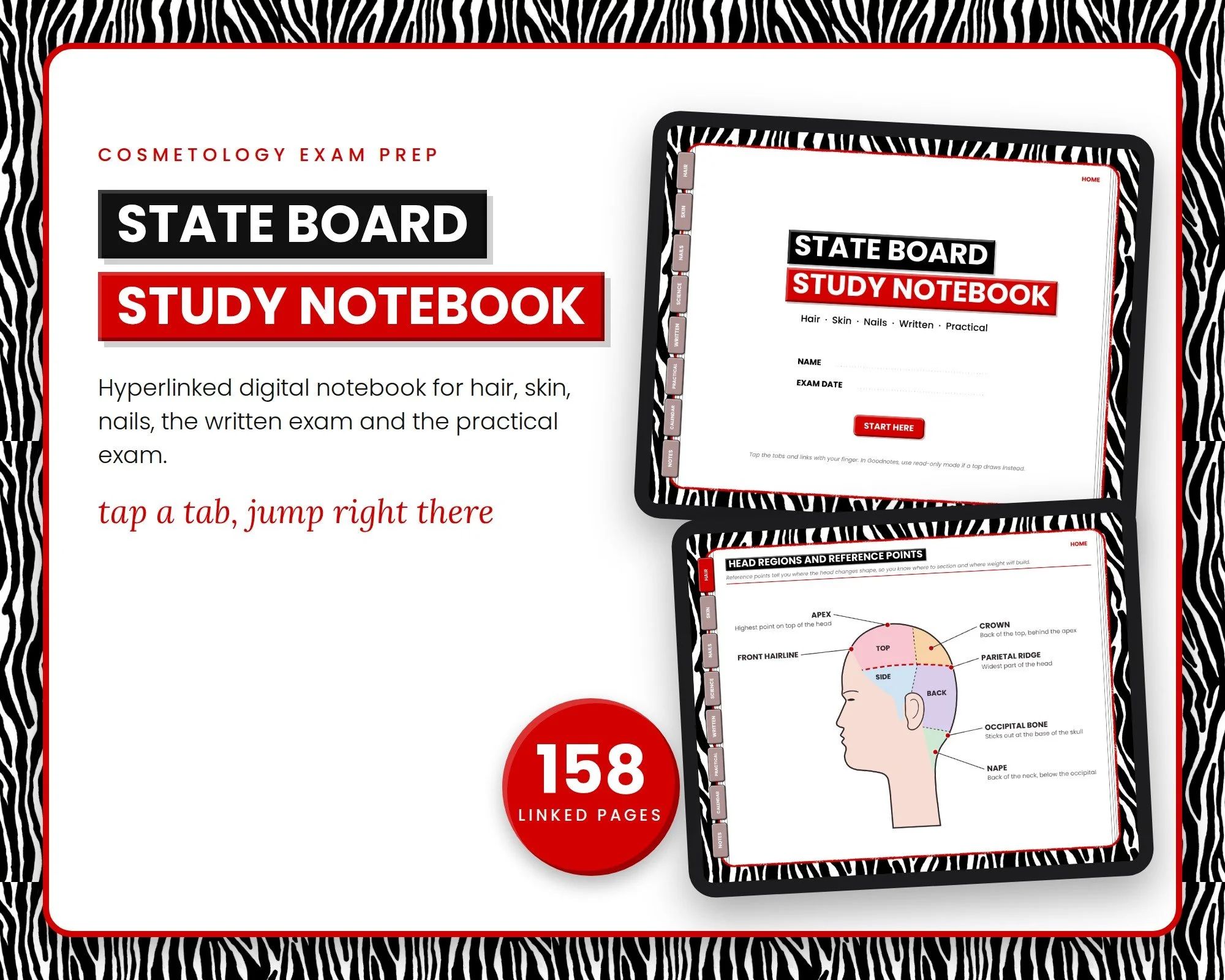
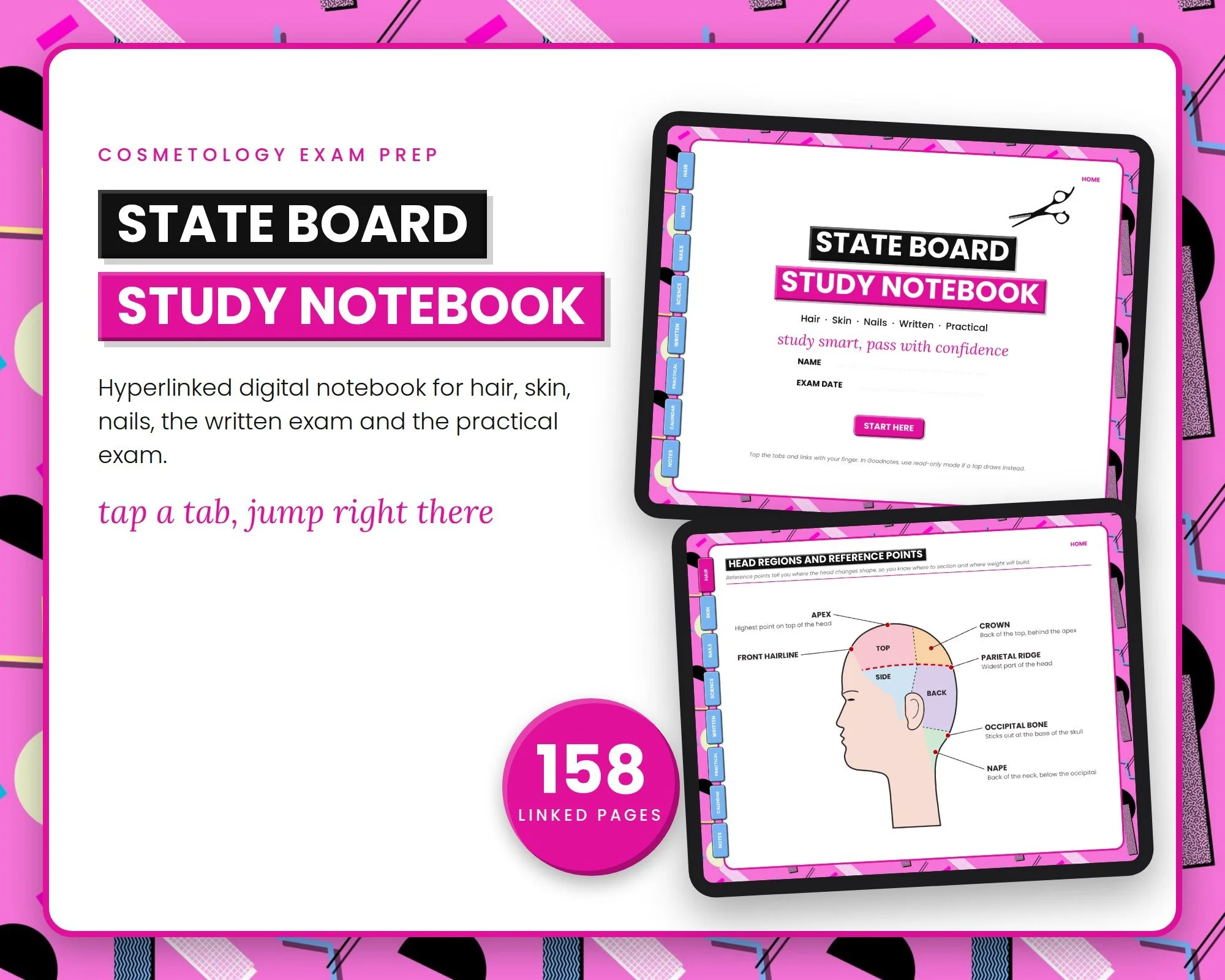
State Board Study Notebook ($13.50, regularly $18). This is a 158-page hyperlinked digital notebook for your iPad or tablet. It has 560+ vocabulary terms, 200 review questions with a linked answer key and quick reference charts. It also has labeled diagrams of cutting elevations, head regions, skin layers, nail structure and the pH scale. The 8-week written exam plan from this post is in there too, along with practical exam checklists and a study planner. Choose Zebra or 80s Retro.
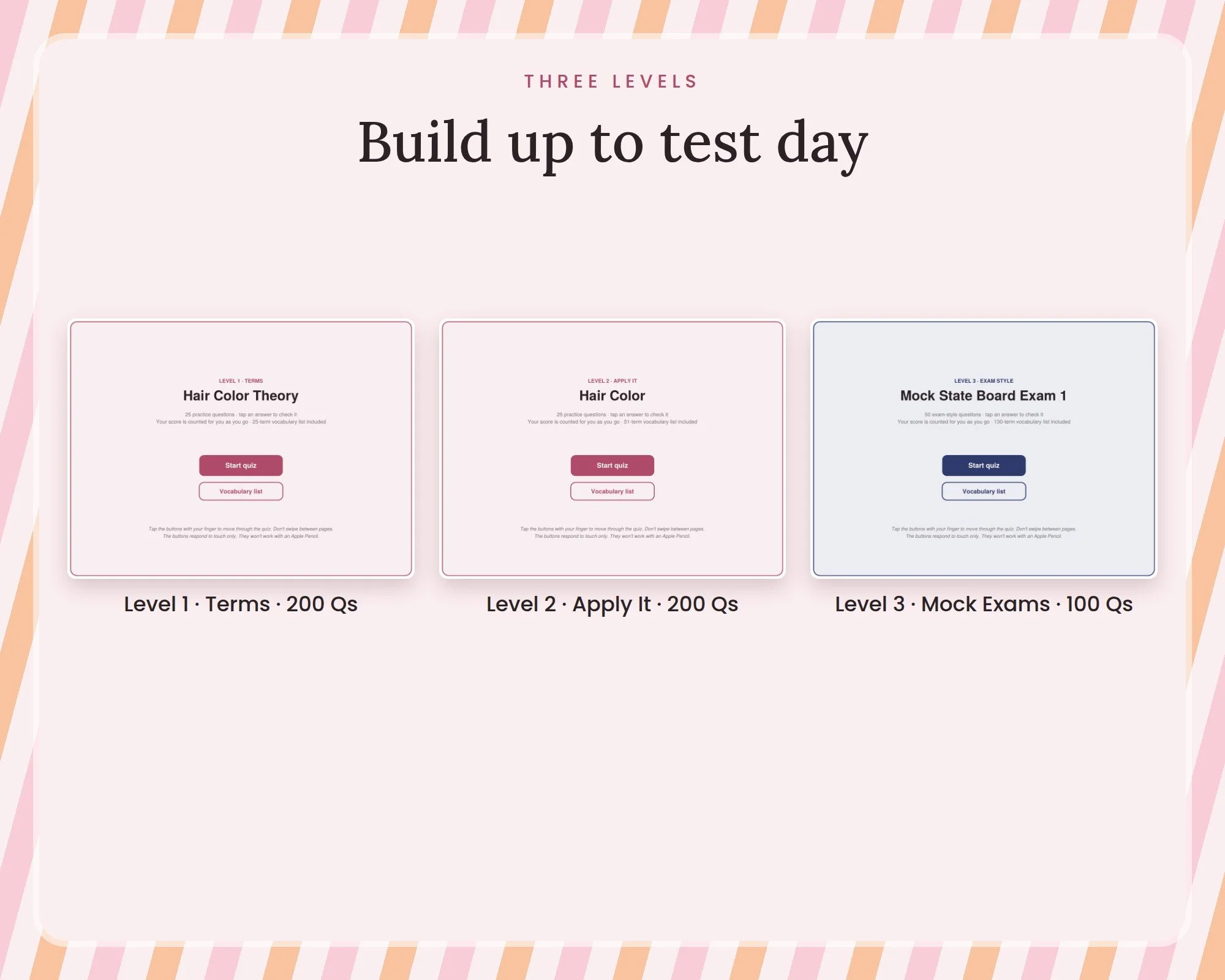
Practice quiz sets (from $7.50). These are original multiple-choice practice questions built around the NIC exam topics, with answer keys. Get them by level, or save with the bundle of all 500 questions ($19.50, regularly $26).
Shop the Cosmetology Study Tools
Already licensed? I also make Canva templates for working stylists, including Instagram post packs for extension and thinning-hair clients and an editable business card.
You've got this. Study a little every day, learn the why behind the terms, and walk into that exam knowing you're ready. I can't wait to welcome you to the industry.