How to Study for the Cosmetology State Board
A Boise stylist’s plan for passing the cosmetology state board on your first try: what’s on the NIC exam, an 8-week study plan, practical exam prep and test-day tips.
You can pass the cosmetology state board on your first try if you study in the right order: learn the terms, practice applying them, then take timed mock exams. I'm a working hair extension stylist in Boise, and I train apprentices for this exam. This is the plan I give them.
Whether you're in beauty school or an apprenticeship, the state board is two tests: a written (theory) exam and a hands-on practical exam. Here's how to get ready for both.
Know your exam before you study for it
Most states use exams written by the National-Interstate Council of State Boards of Cosmetology (NIC). There are two parts, and you usually have to pass both.
The written (theory) exam. The NIC cosmetology theory exam has 110 multiple-choice questions, and 100 of them count toward your score. Each question has four answer choices, and you get 90 minutes. The content is weighted roughly like this:
Hair care and services: about 45%. Cutting, color, chemical texture, styling and scalp care.
Scientific concepts: about 35%. Infection control, safety, anatomy, chemistry and electricity.
Skin care and services: about 10%.
Nail care and services: about 10%.
Look at that split. Science is more than a third of the test, and it's the part most students skip because it feels less fun than hair. Don't skip it.
The practical exam. You perform timed services on a mannequin while an examiner grades your technique. They also watch your infection control and safety at every step. You can do a beautiful finger wave and still lose points for setting a dirty comb on your clean station.
Check your own state. Testing companies, fees, passing scores and what to bring all vary by state. Before you build a study plan, download your state board's candidate information bulletin and read the whole thing. In Idaho, start with the Idaho Board of Cosmetology through the Division of Occupational and Professional Licenses (DOPL).
An 8-week study plan that works
Cramming doesn't work for this test. There are too many terms, and the questions are worded to catch you if you only half know something. Here's the plan I give my apprentices.
8 weeks out
Read your state's candidate bulletin and schedule your exam date.
Take one full practice test cold. Don't study first. Your score shows you where you stand.
Write down every topic you missed. That list becomes your study map.
6 weeks out
Start with science: infection control, decontamination levels, bacteria, chemistry, pH and electricity.
Study 30 to 45 minutes a day, not three hours on Sunday.
Make flash cards for every term you can't define out loud.
4 weeks out
Move to hair: color levels and developer strength, the color wheel, cutting elevations, head regions and chemical texture.
Take a timed practice test each week and track your score.
Start practicing your practical services with a timer.
2 weeks out
Cover skin and nails: skin layers, lesions, massage movements and nail structure.
Go back to your missed-terms list and quiz yourself only on those.
Do a full practical run-through with your complete kit.
1 week out
Review, don't learn anything new.
Take your last full practice test under real test conditions.
Pack and label your practical kit.
The night before
Skim your missed-terms list one last time, then put it away.
Lay out your ID, admission letter and kit.
Go to bed early. A rested brain remembers more than a crammed one.
Study tips that make it stick
Say it out loud. If you can explain a term to someone else without looking, you know it. If you can only recognize it in a list, you don't know it yet.
Learn the why, not just the word. Don't just memorize that a level 10 is the lightest blonde. Know why you'd need a higher-volume developer to lift there. The test asks the same idea in different ways, and understanding covers all of them.
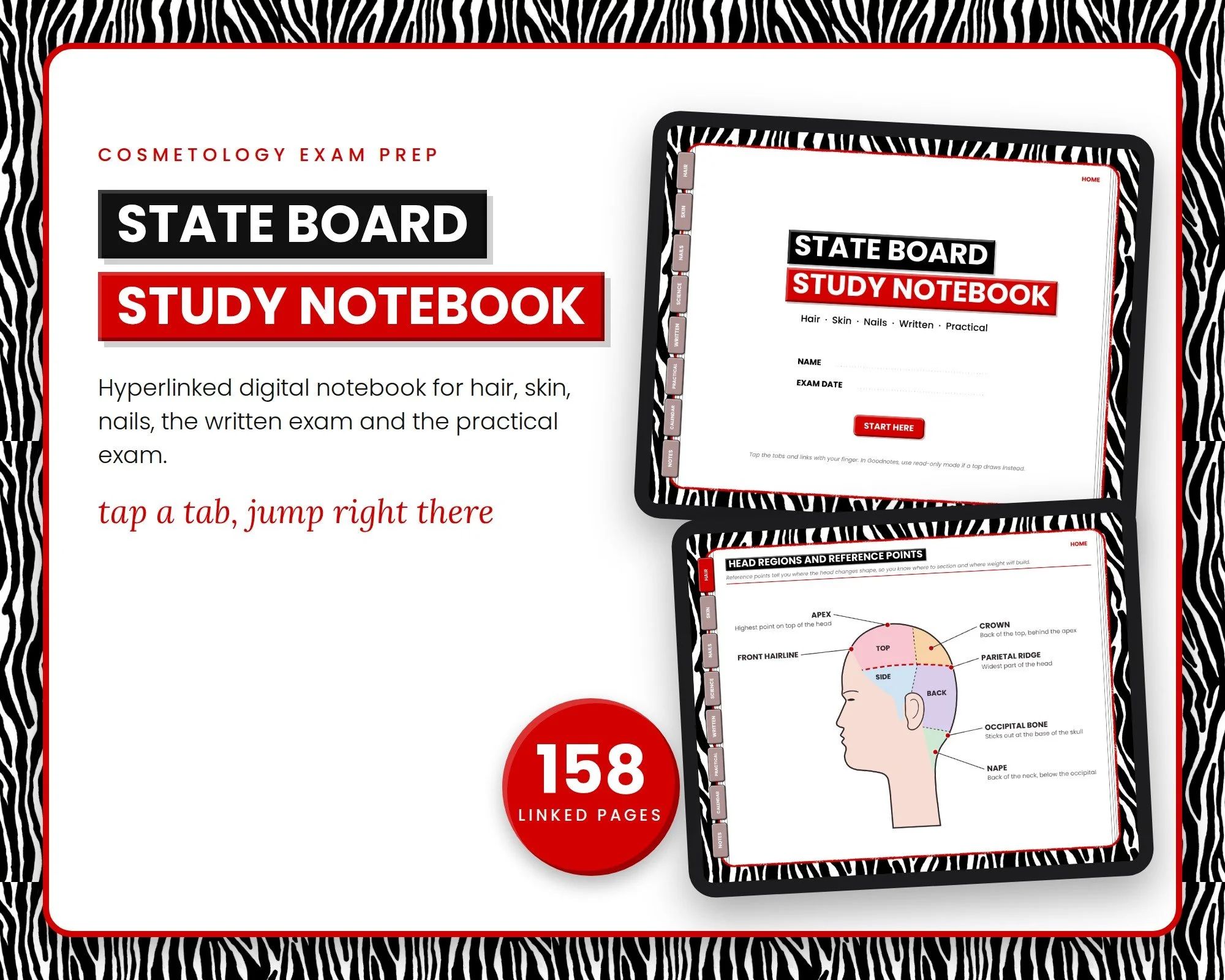
Use pictures for the visual stuff. Elevations, head regions, skin layers and nail anatomy are much easier to remember from a labeled diagram than from a paragraph. Draw them yourself from memory, then check your drawing.
Keep a missed-terms list. Every time you get a question wrong, write the term down. Review that list more than anything else. It's your personal study guide.
Practice under real conditions. Time yourself. Take practice tests in one sitting with your phone in another room. The 90 minutes goes faster than you think.
Read every answer choice. The NIC likes answers that are almost right. Rule out the two that are clearly wrong, then compare the last two carefully.
Study in short sessions. Thirty focused minutes a day beats a five-hour cram. Your brain stores information while you sleep, so spreading it out helps.
Getting ready for the practical exam
The practical is where good stylists lose easy points. Usually it isn't skill that costs them, it's nerves and sloppy setup.
Build your kit from the bulletin's supply list. Check off every item, then pack spares of anything that can break or run out.
Label everything. Keep clean and dirty items clearly separated, and use the containers your state requires.
Practice infection control until it's automatic. Wash or sanitize your hands, disinfect tools and protect your client (mannequin) every time, even when you're practicing at home.
Practice each service with a timer. Know exactly how many minutes you have for each one, and finish with time to spare.
Run through the steps in your head as you work. It keeps you in order when your nerves kick in.
Do at least one full dress rehearsal. Set up your station, run every service back to back and clean up, just like test day.
Test-day tips
Eat a real breakfast and bring water if your testing site allows it.
Arrive early. Bring your government ID and admission letter exactly as your bulletin describes.
Answer every question. Wrong answers usually don't cost extra, so never leave one blank. Check your bulletin to be sure.
Flag and move on. If a question stumps you, mark it and come back. Don't burn five minutes on one question.
Trust your first answer unless you find a clear reason to change it.
Breathe. You've done the work. The test is just showing what you already know.
Study tools I made for you
When I couldn't find study materials I liked for my apprentices, I made my own. They're all instant digital downloads, and they're on sale for 25% off through November 10.
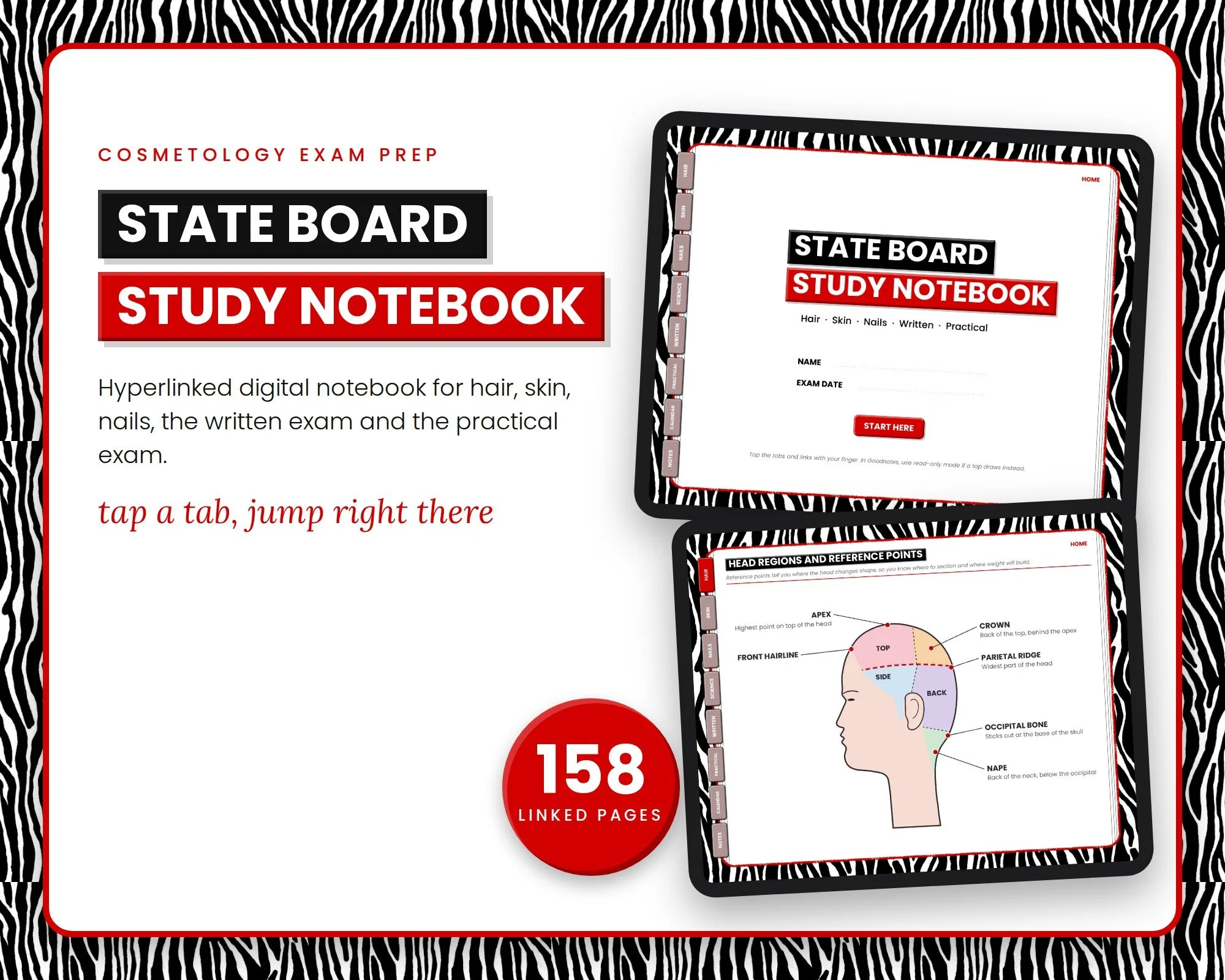
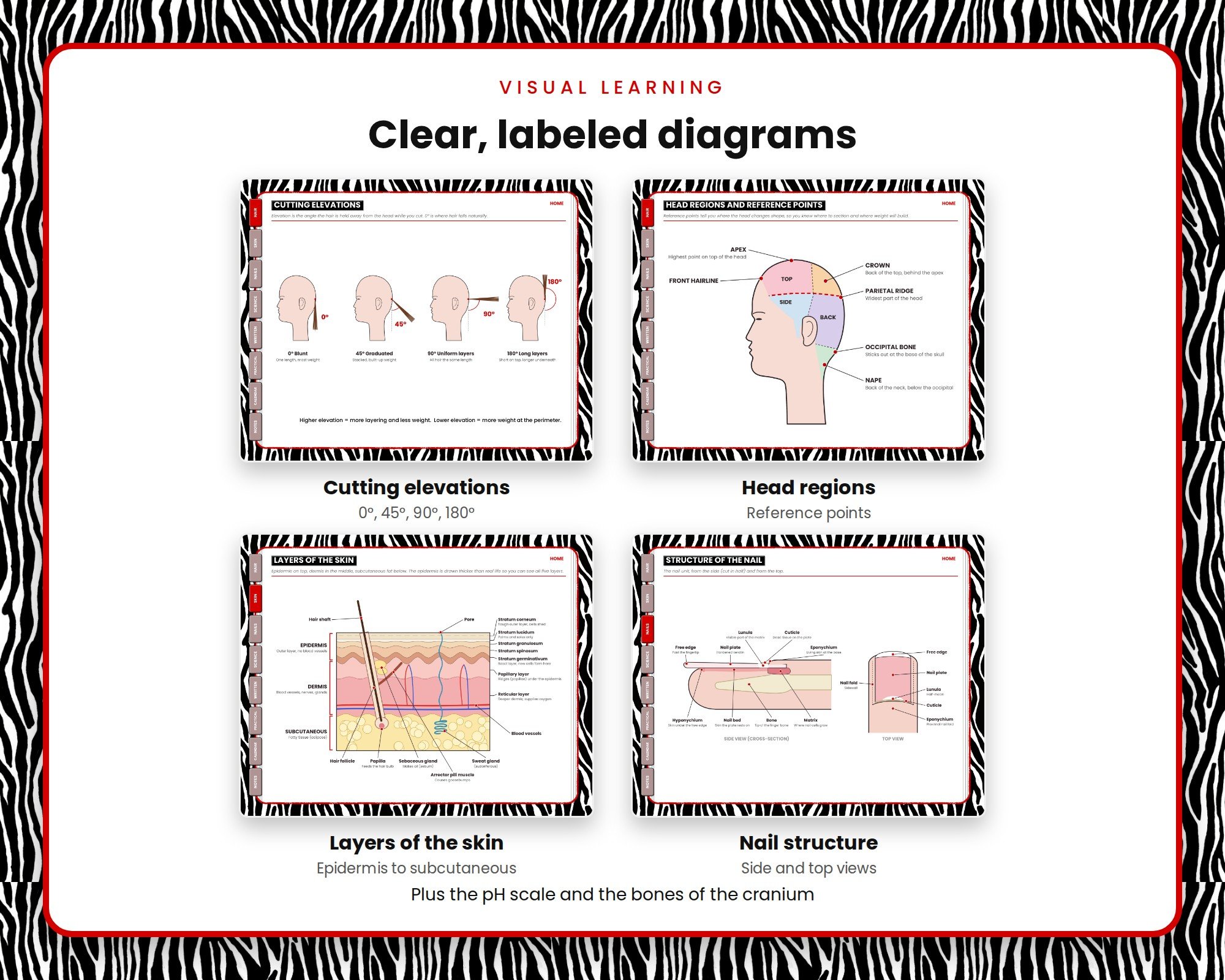
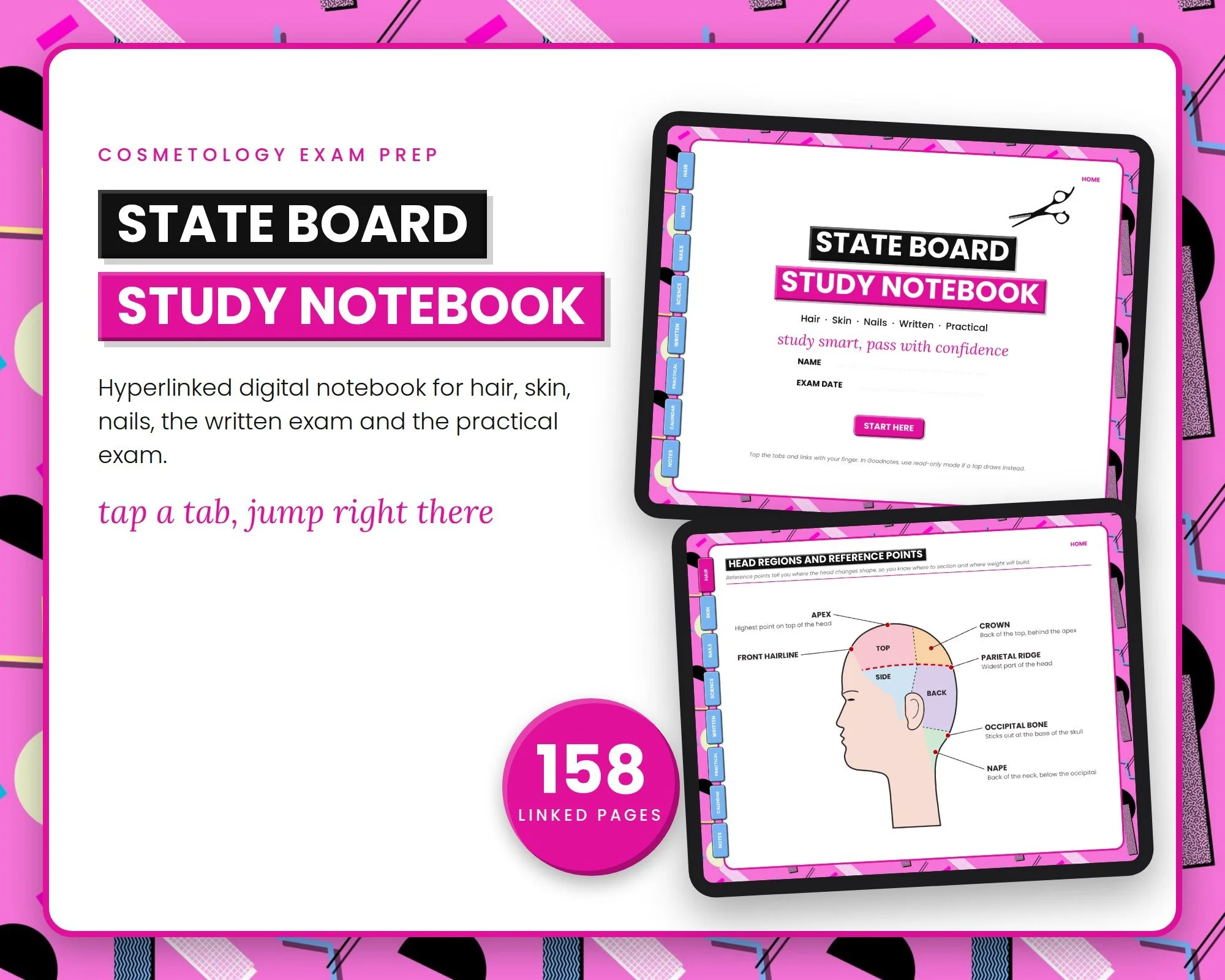
State Board Study Notebook ($13.50, regularly $18). This is a 158-page hyperlinked digital notebook for your iPad or tablet. It has 560+ vocabulary terms, 200 review questions with a linked answer key and quick reference charts. It also has labeled diagrams of cutting elevations, head regions, skin layers, nail structure and the pH scale. The 8-week written exam plan from this post is in there too, along with practical exam checklists and a study planner. Choose Zebra or 80s Retro.
Practice quiz sets (from $7.50). These are original multiple-choice practice questions built around the NIC exam topics, with answer keys. Get them by level, or save with the bundle of all 500 questions ($19.50, regularly $26).

Shop the Cosmetology Study Tools
Already licensed? I also make Canva templates for working stylists, including Instagram post packs for extension and thinning-hair clients and an editable business card.
You've got this. Study a little every day, learn the why behind the terms, and walk into that exam knowing you're ready. I can't wait to welcome you to the industry.

Hair Extensions in Boise: Recent Work and Meet Julia Bridges
Microbead, fusion and tape-in hair extensions in Boise, ID. See recent before-and-after work and meet my apprentice stylist, Julia Bridges.
It's been a full few weeks in the chair, and I wanted to share some of my favorite recent results. I also want to properly introduce someone many of you have already met: my daughter, Julia Bridges. Julia has been working alongside me at Fusion Studio through a cosmetology apprenticeship for a year now, and getting to teach her this craft in my own salon is something I never take for granted.
Meet Julia Bridges
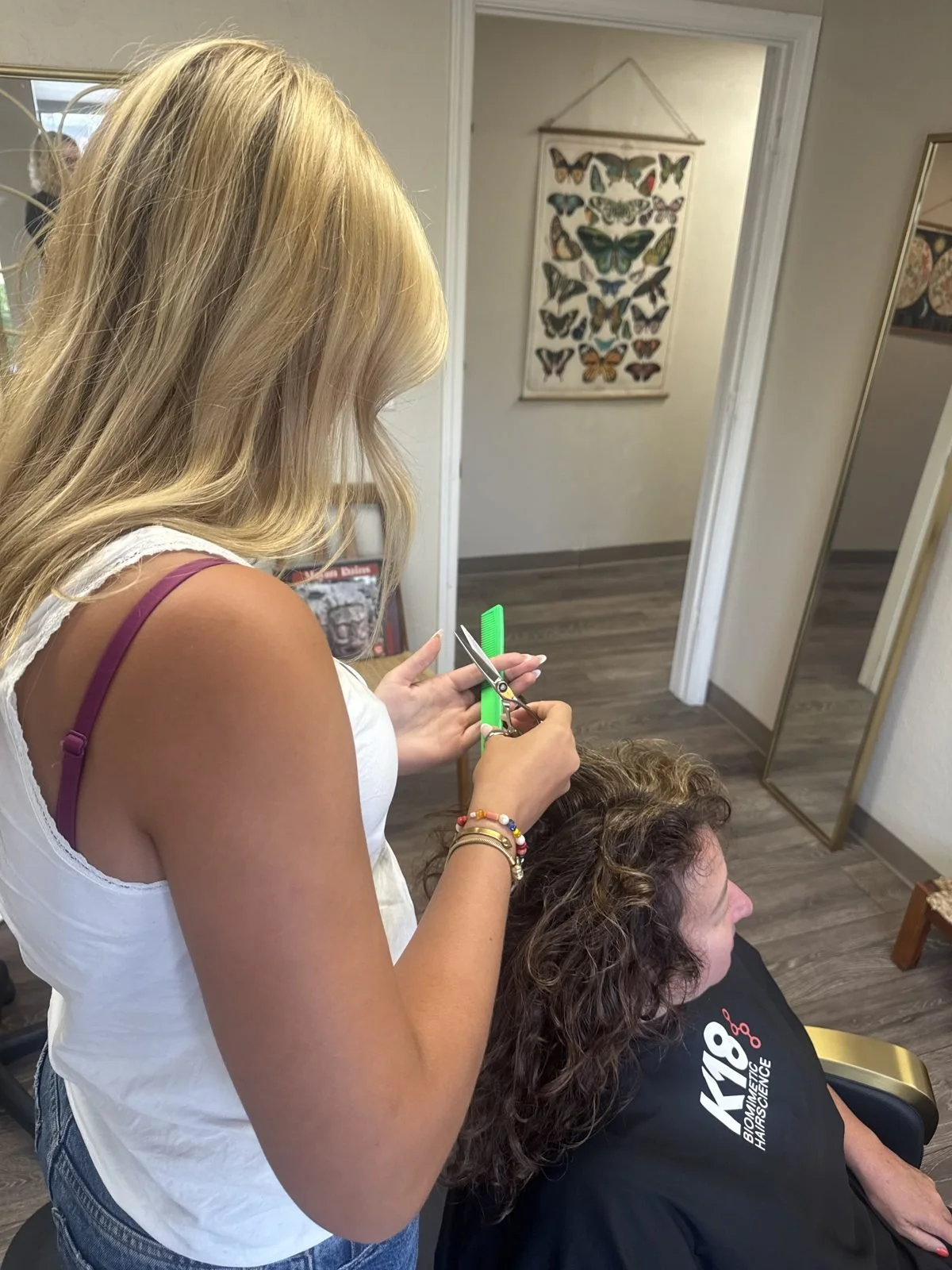
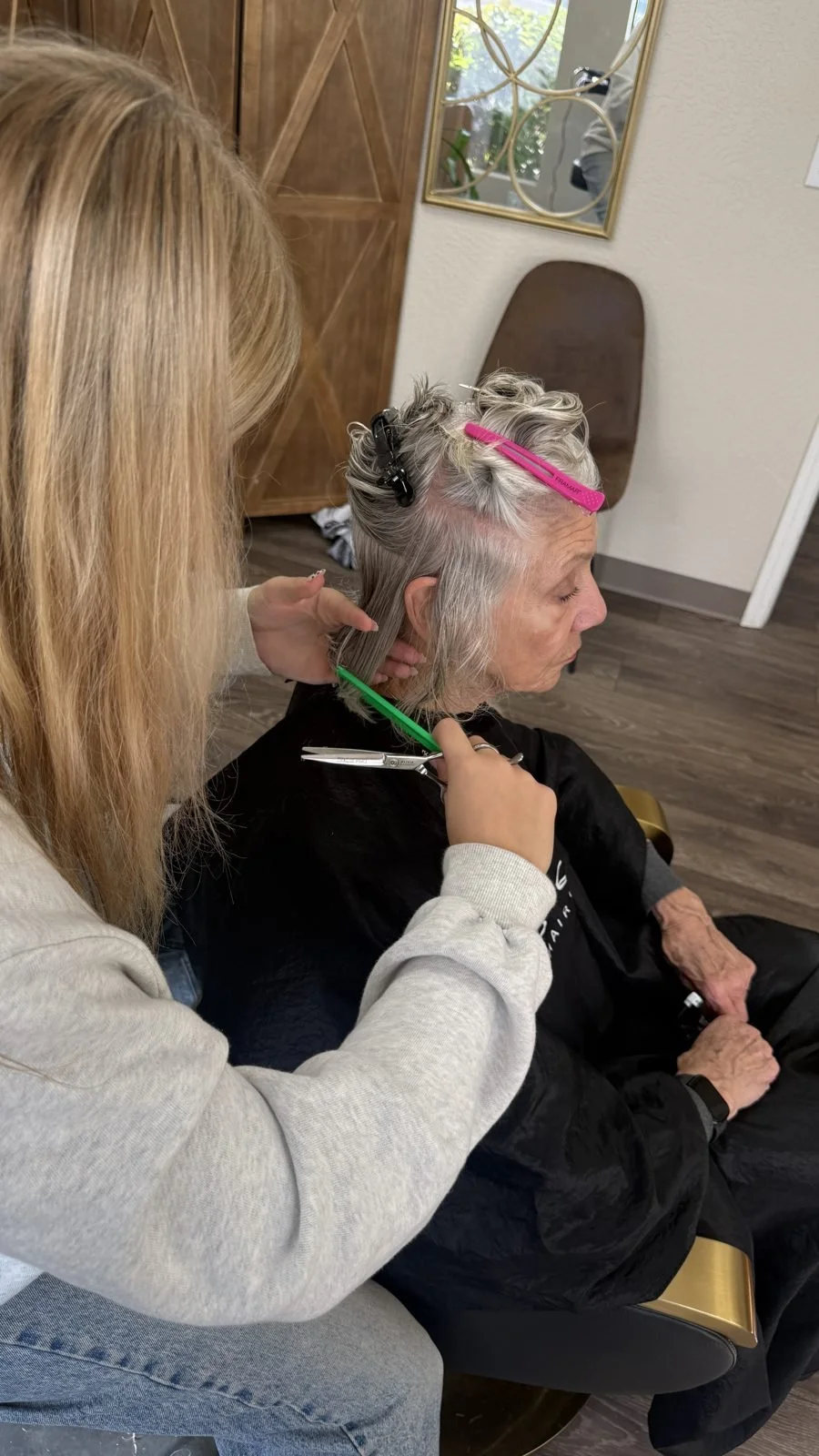
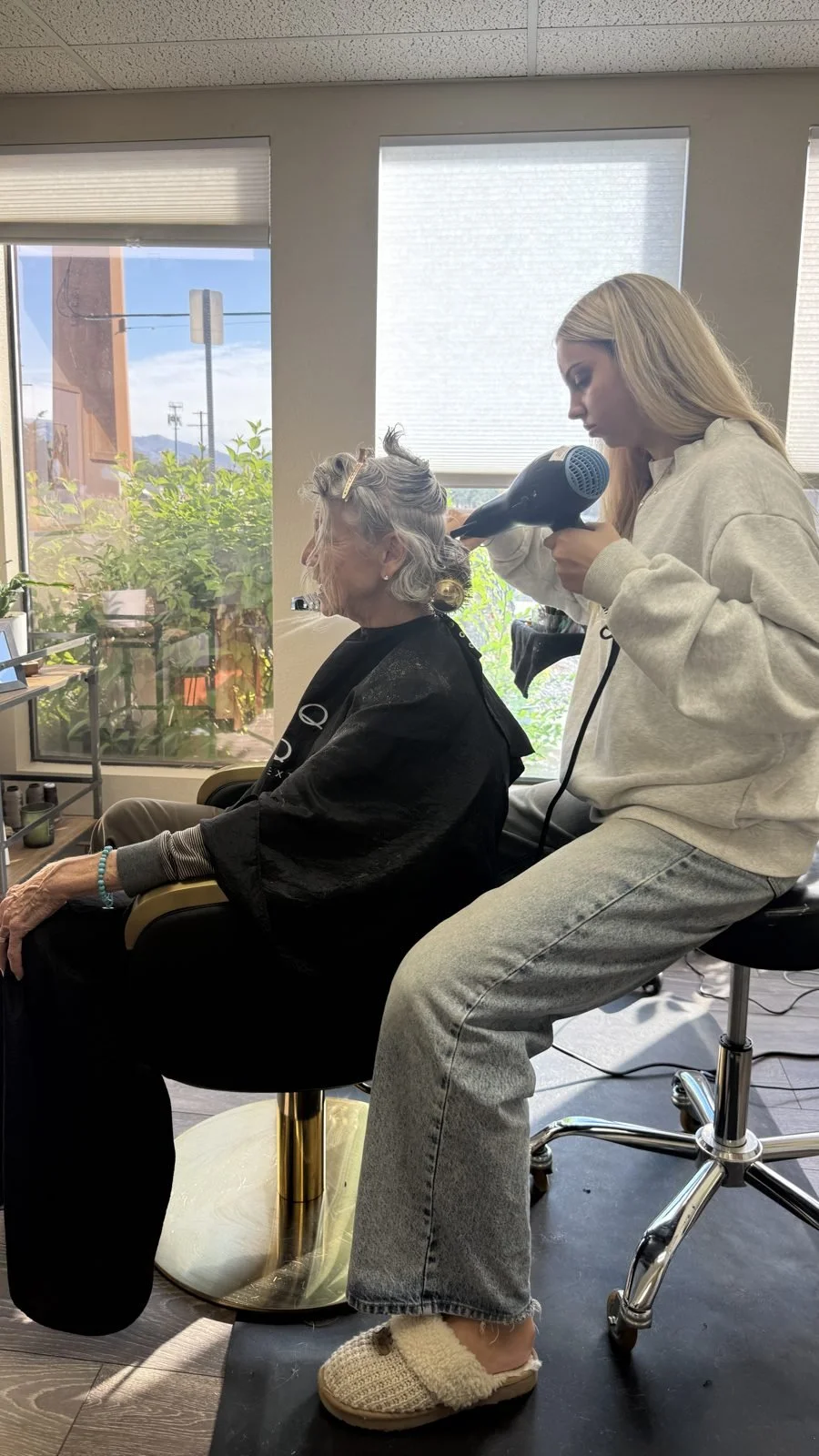
If you've been in over the past year, there's a good chance you've seen Julia working right beside me. She's spent that year learning everything hands-on: consultations, cuts, color, and of course the extension work Fusion Studio is known for. All that practice is paying off, and Julia is now booking her own clients too.
Apprenticeships are one of the best ways to learn this trade. Instead of only working on mannequins, apprentices learn on real hair, with real clients, side by side with a licensed stylist. I'm so proud of how far Julia has come, and I'm proud to be the one teaching her. If you'd like to book with Julia, just mention her name when you schedule.
Before and after: soft, long blonde with extensions
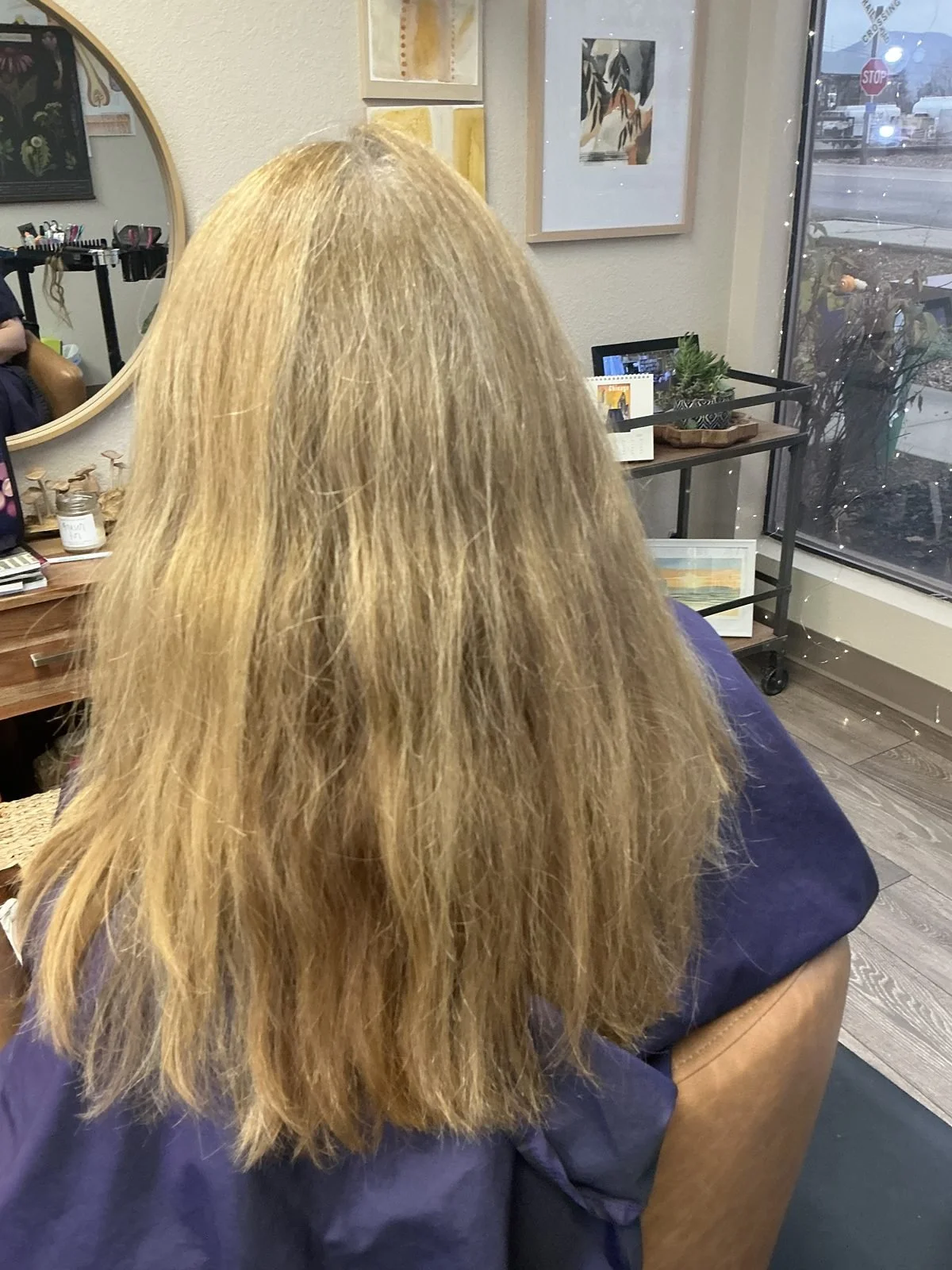
This client came in wanting length and fullness without her hair looking "done." Her ends had grown uneven and thin, which is really common, especially after summer sun and color. We added extensions matched to her blonde, blended them with a fresh cut, and finished with soft waves. The result is fuller, longer hair that moves like her own.
Dimensional blonde with soft layers
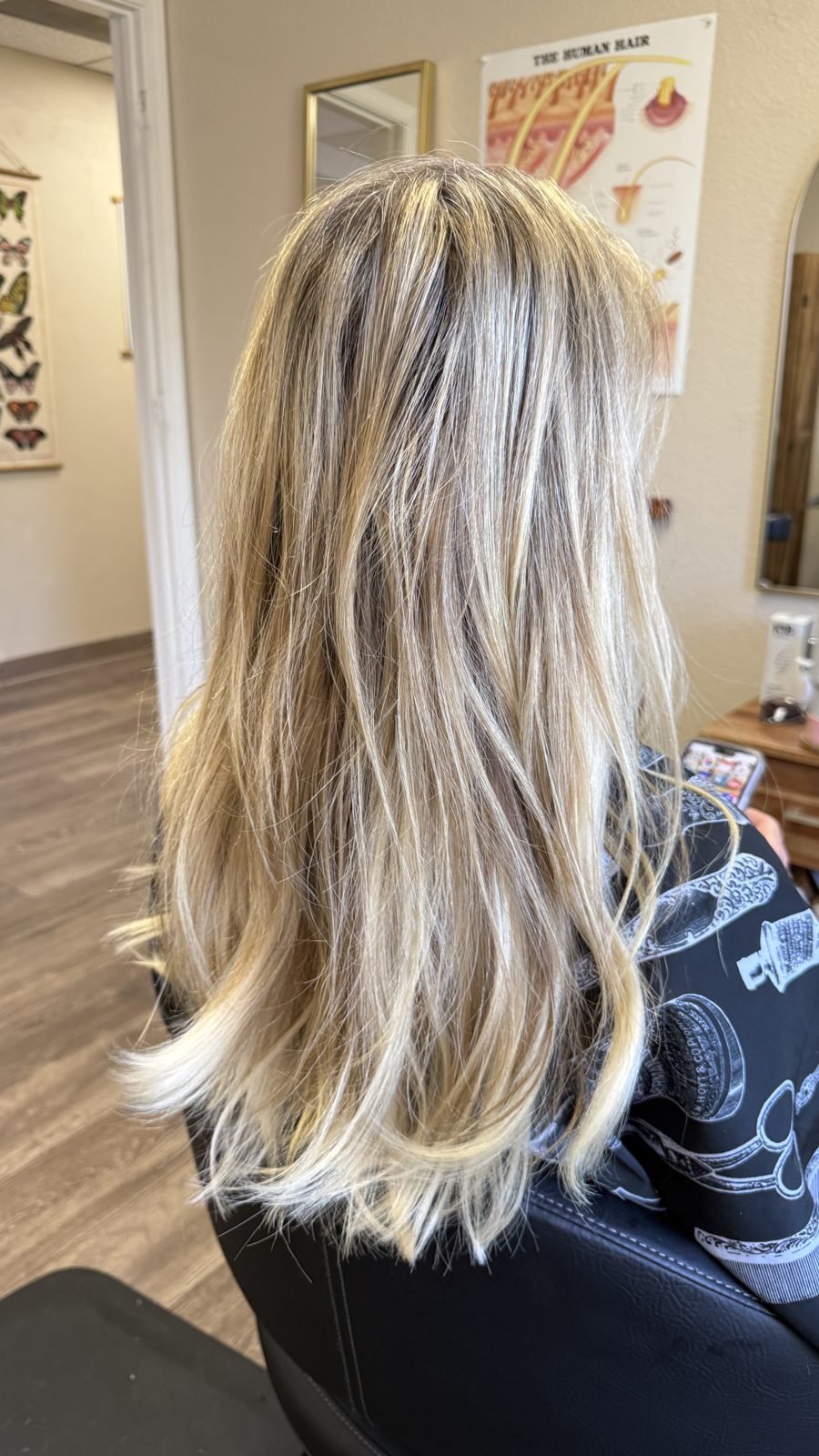
Not every visit is all about extensions. This client wanted brightness without losing depth, so we placed highlights to keep some of her natural root showing through, then added soft layers so the color moves. It grows out beautifully and keeps that sun-kissed look between appointments. Also completed a extension refresh.
Silver blonde, start to finish
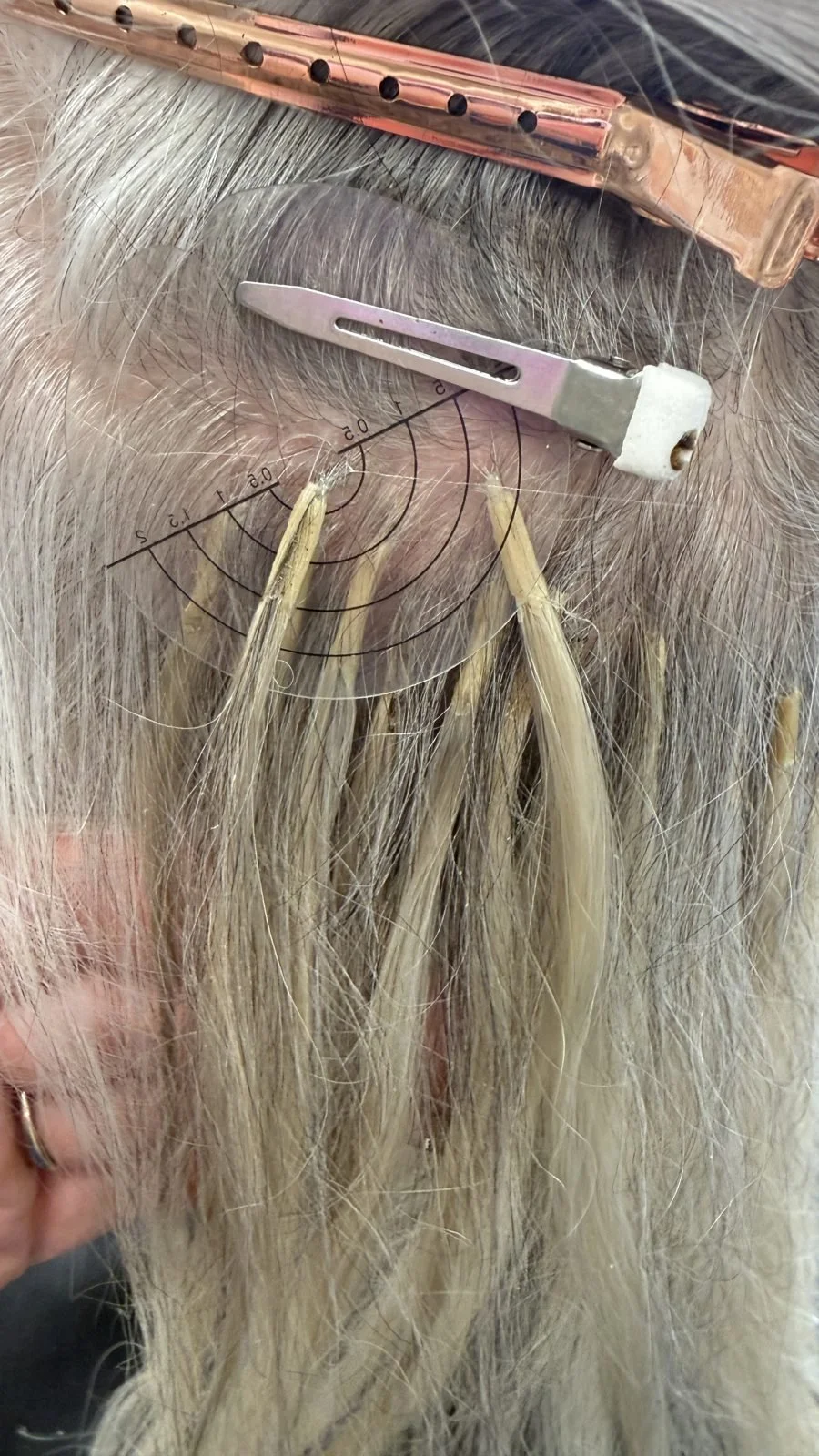
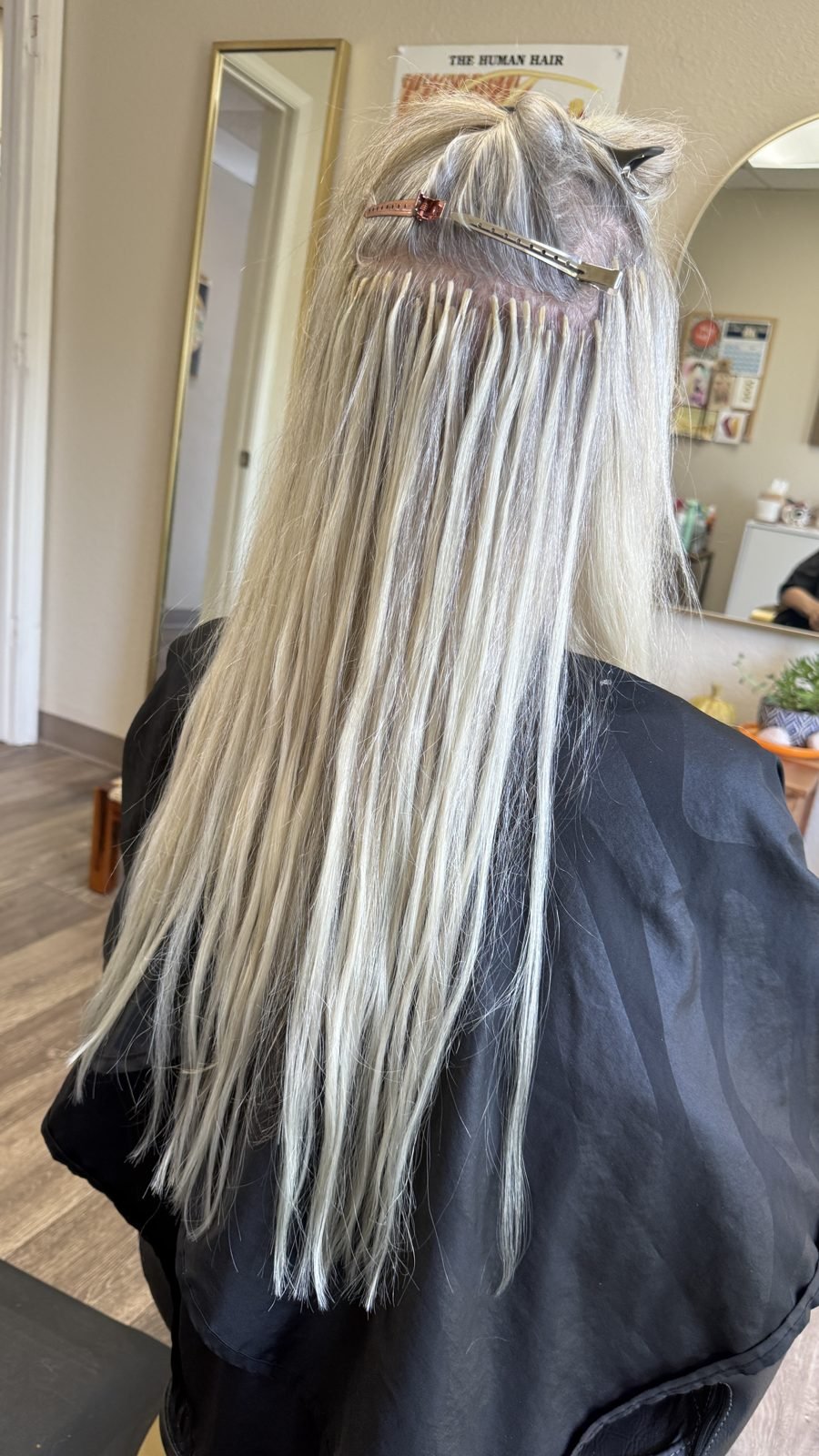
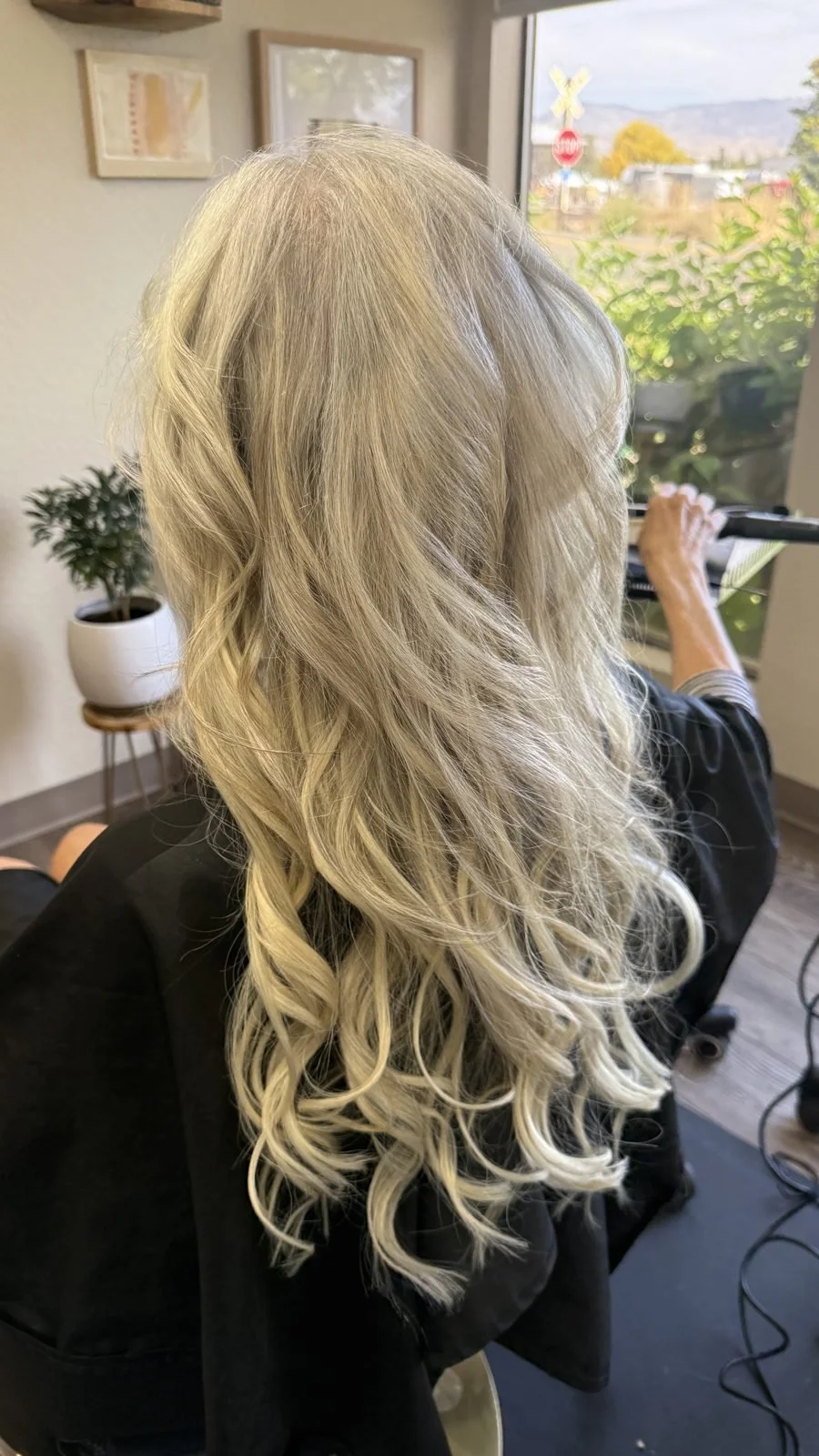
Gray and silver hair deserves extensions too, and color matching matters even more here. For this client, every row was mapped out before a single bead went in, so the extensions sit evenly and stay hidden under her natural hair. Once everything was installed, we blended the length with a cut and finished with loose curls. The result is long, bright, silver-blonde hair that looks completely her own.
Microbead extensions, up close
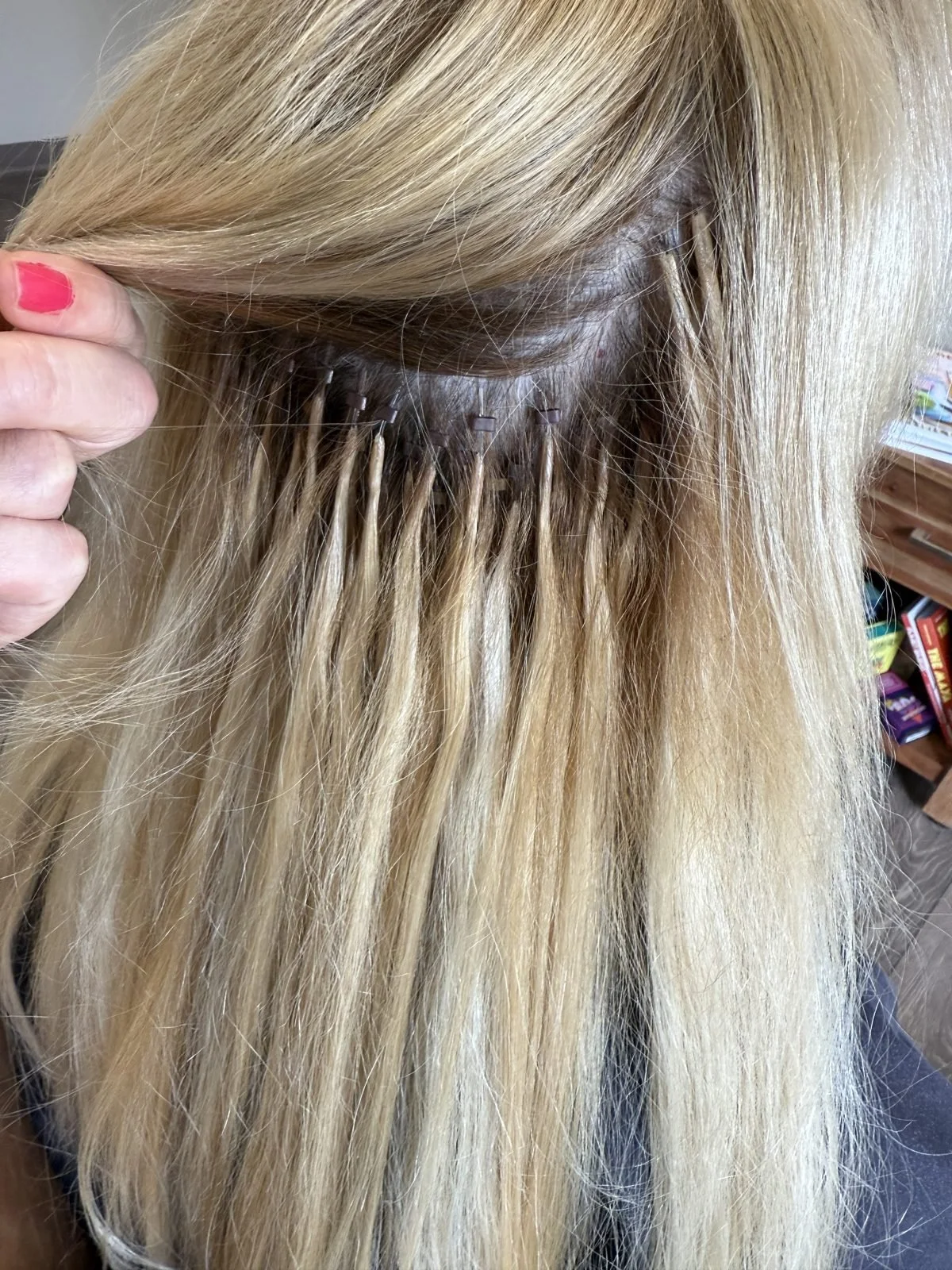
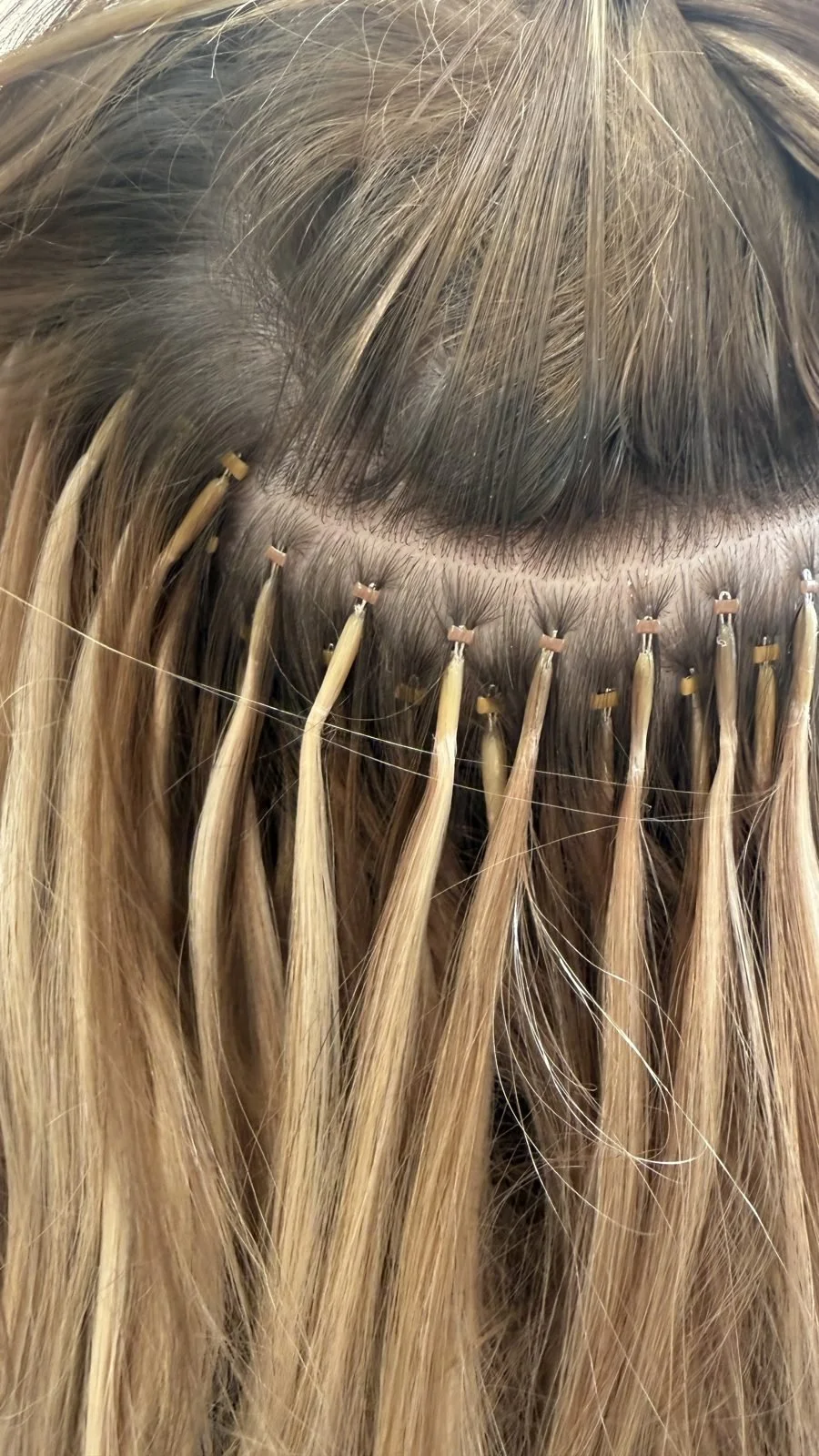
Microbead extensions (also called micro-links or I-tips) attach to small sections of your natural hair with a tiny bead. No glue, no heat, and they're comfortable and gentle on your hair when they're placed and maintained correctly. Here you can see how neat and evenly spaced the rows are, on blonde balayage and on dark brunette alike. Beads are color matched to your hair, and once the top section is down, they're designed to blend right in. These extensions were purchased by the client and brought into the salon. I had not previously seen such a small insertion loop into the beads.
Microbeads are a great fit if you:
Want an extension method with no adhesive or heat
Like being able to have them moved up and reused at maintenance appointments
Have fine to medium hair and want natural-looking volume
Yes, extensions work on curly hair too
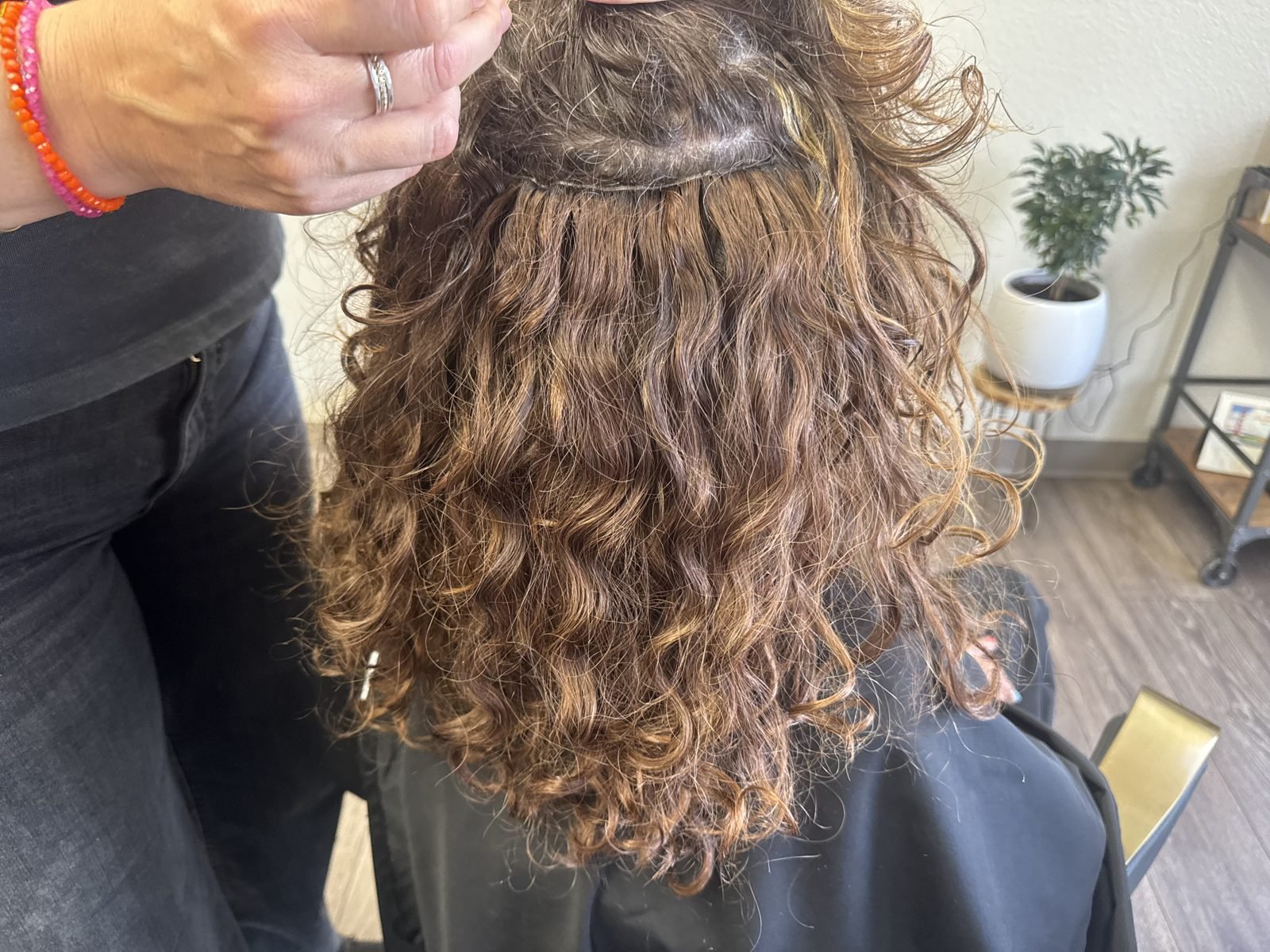
One of the questions I hear most is, "Can I get extensions if my hair is curly?" Absolutely. The key is matching the texture as well as the color, and placing the rows so the curls fall naturally over them. This client's extensions blend right into her natural curl pattern.
Tape-in extensions for quick, flat volume
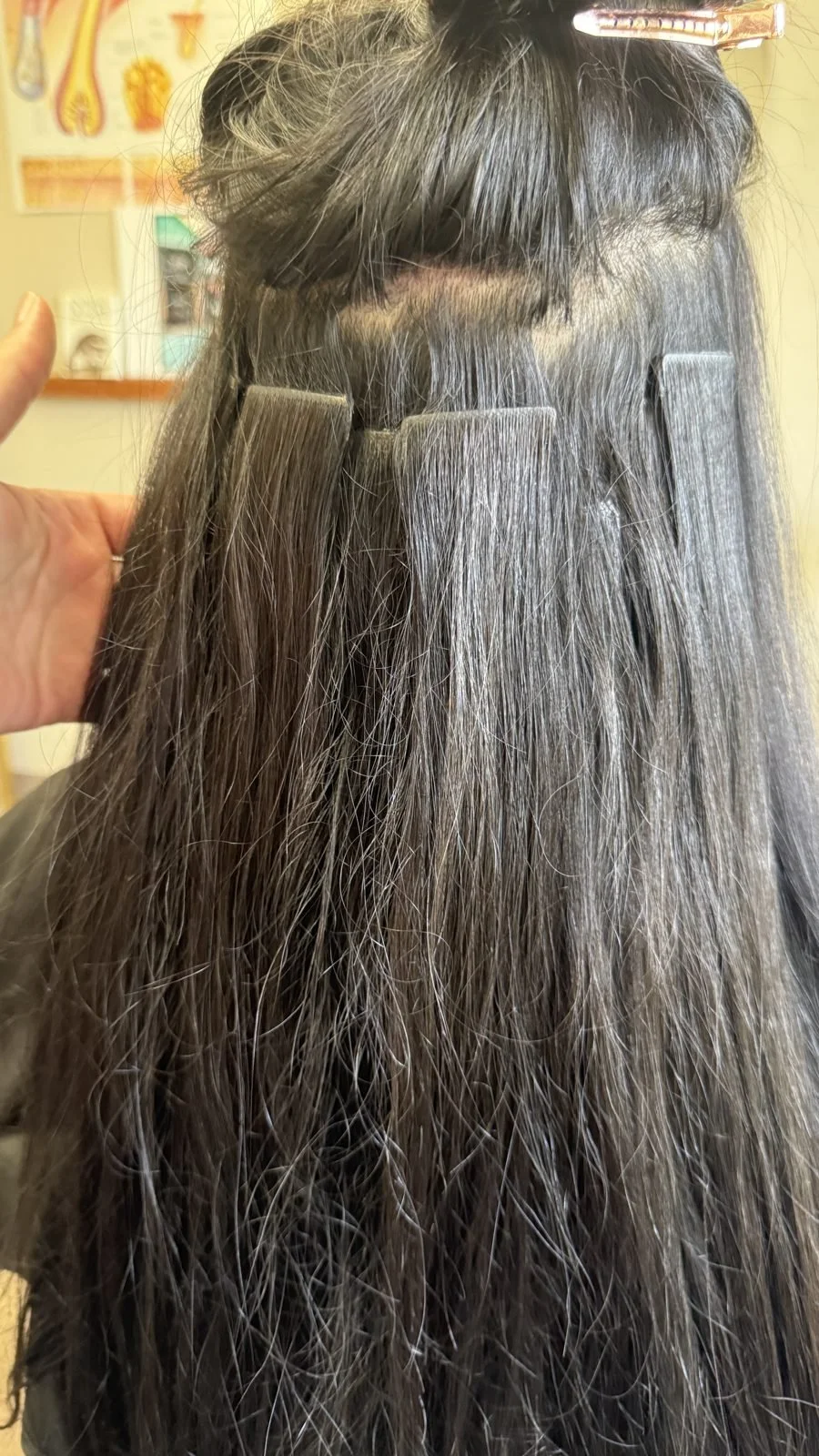
Tape-ins are thin panels of hair that sandwich a small section of your own hair. They lie very flat, go in quickly, and are a great way to add fullness, especially if you're new to extensions. This example shows grown out tape in extensions at about 2 months from last removal and replacement.
Microbead, fusion or tape-in: which is right for you?
I offer microbead, fusion (keratin bond) and tape-in extensions, and the right choice depends on your hair, your lifestyle, and how often you want to come in.
Microbead: no glue or heat, reusable hair, maintenance about every 6 to 8 weeks.
Fusion: individual keratin bonds, very flat and flexible, longer wear between appointments.
Tape-in: fast install, very flat, reusable panels that get re-taped and moved up about every 6 to 8 weeks.
The best way to know is a consultation. We'll look at your hair together, talk about what you want, and match color and texture before anything is ordered.
Book your extension consultation in Boise
If you've been thinking about longer, fuller hair, Julia and I would love to help. Whether you're in Boise, Meridian, Eagle, Garden City, or Nampa, book a consultation and let's talk about which extension method fits you best.
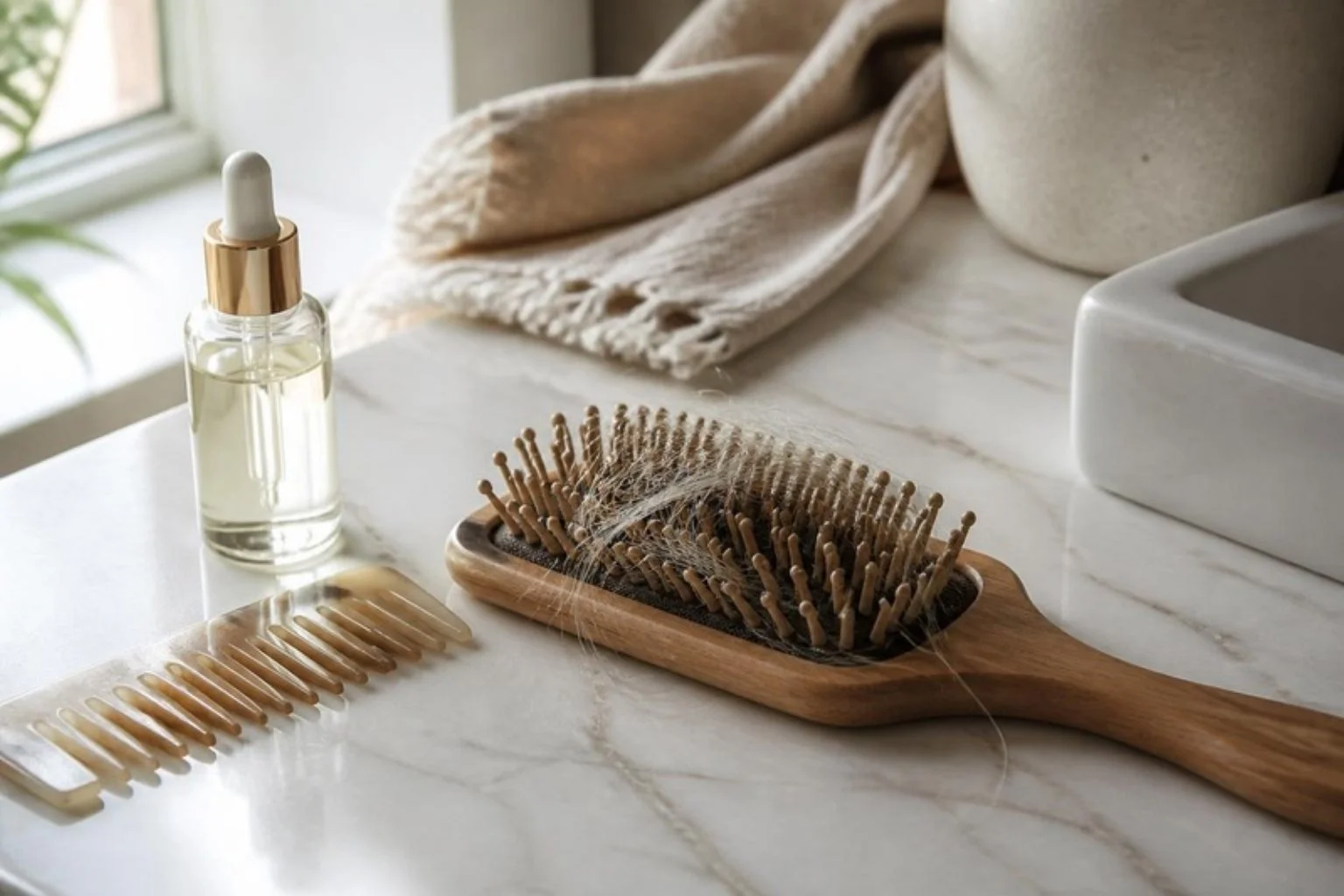
Hair Shedding and Scalp Aging: What’s Normal and What Helps
How much hair shedding is normal, why it can suddenly pick up, how your scalp changes with age, and simple ways to keep your hair healthy. Tips from a Boise hair stylist.
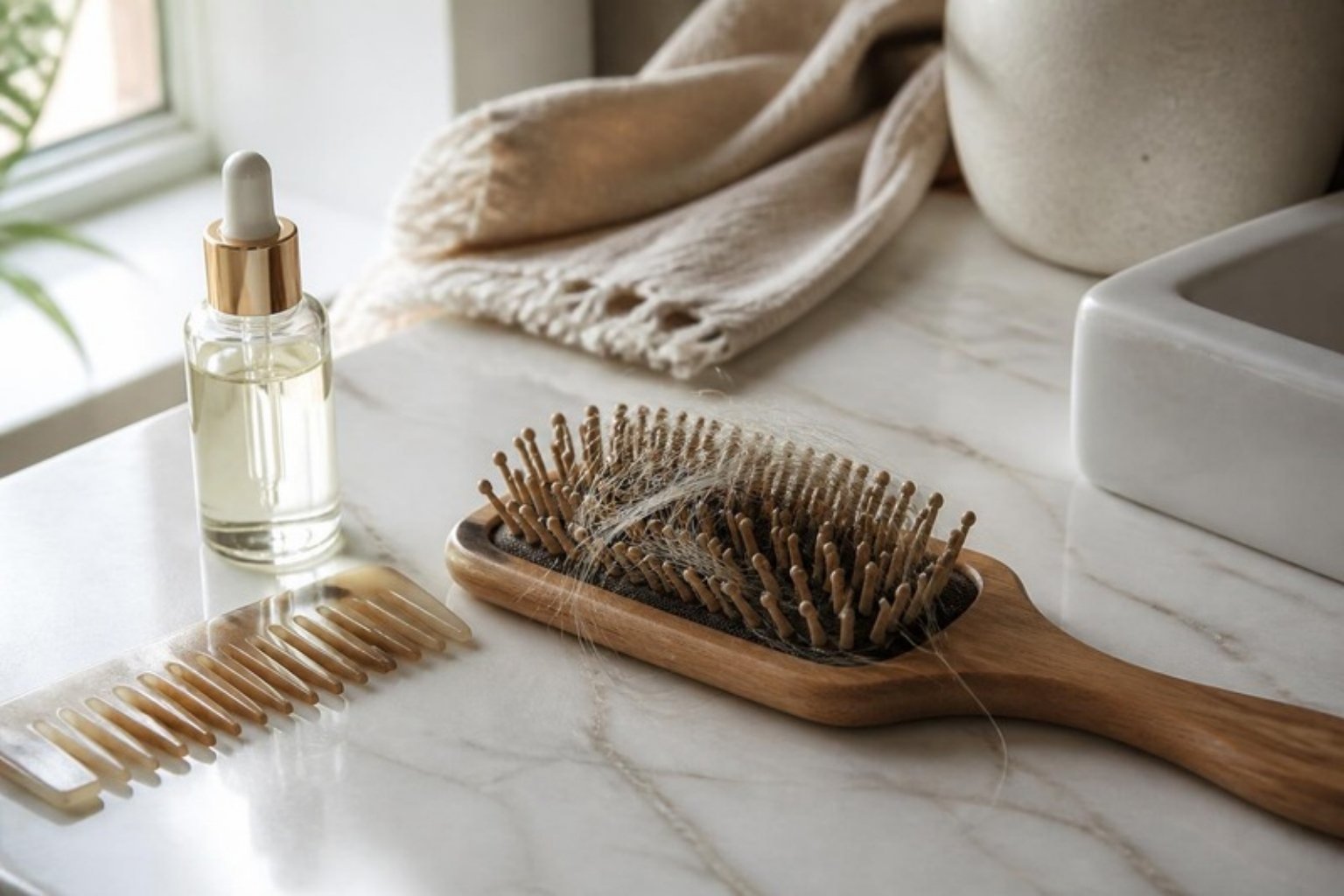
If you've ever looked at your hairbrush or the shower drain and thought, "Is this too much?", you're not alone. It's one of the questions I hear most in my chair. The short answer: some shedding every day is completely normal, and your scalp changes as you get older, just like your skin does. Here's what's going on and what you can do about it.
How much shedding is normal?
Most people lose somewhere around 50 to 100 hairs a day. That sounds like a lot, but you have roughly 100,000 hairs on your head, and new ones are always growing in to replace the old.
Every hair goes through a cycle. It grows for a few years, rests for a few months, then falls out so a new hair can take its place. You may notice more hair on wash day or after you brush, simply because those loose hairs collect and come out all at once.
Why you might suddenly shed more
A sudden increase in shedding usually has a trigger. Common ones include:
A stressful event, illness or surgery
Having a baby
Big changes in diet or quick weight loss
Hormone changes, including menopause
Starting or stopping certain medications
Here's the tricky part: this kind of shedding often shows up two to three months after the event, so it's easy to miss the connection. The good news is that it usually settles down on its own once your body recovers.
What "scalp aging" really means
Your scalp is skin, and it ages the same way the skin on your face does. Over time:
Hair can grow in finer. Some follicles make thinner, shorter hairs than they used to.
Your scalp makes less oil. That can leave hair drier and more fragile, and the scalp itself can feel tight or flaky.
Hormones shift. For many women, the years around menopause bring thinner hair, especially at the part and crown.
Sun adds up. Years of sun on your part line can leave the scalp drier and more sensitive.
You might notice your part looks a little wider, your ponytail feels smaller, or your hair just doesn't hold a style like it used to. Gray hairs often show up around the same time. Gray hair is a separate change (your hair is making less pigment), but gray strands can feel coarser and drier, so they benefit from the same gentle care.
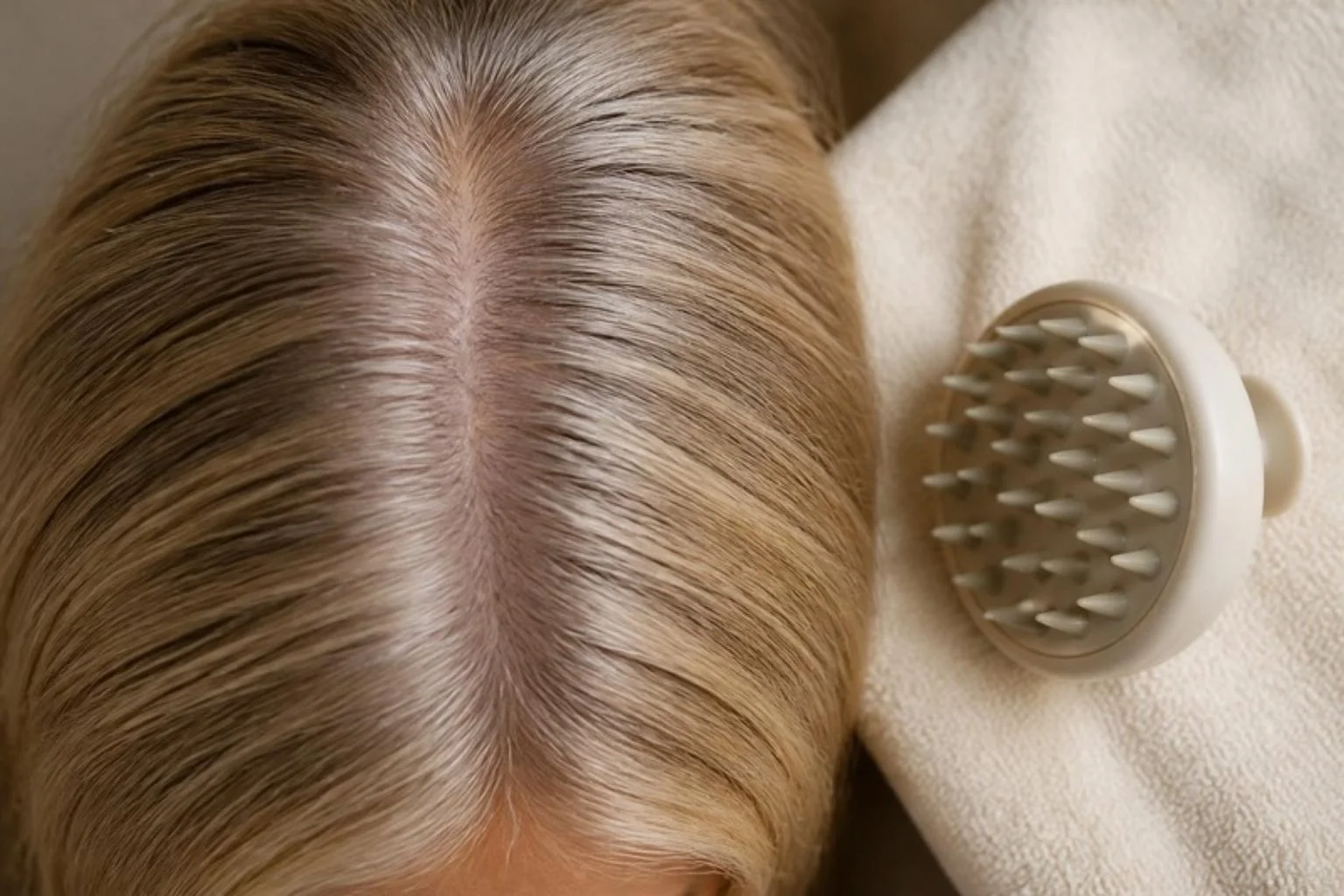
Simple ways to care for an aging scalp
You can't stop time, but you can give your hair the best chance to grow strong:
Be gentle. Use a wide-tooth comb on wet hair, and skip tight ponytails and buns that pull at the root.
Turn down the heat. Use a heat protectant and a lower setting on your dryer and irons.
Treat your scalp like skin. A gentle shampoo, a light massage while you wash, and a hat when you're out in the sun all help.
Eat well. Hair is made of protein, so make sure you're getting enough protein, iron and overall nutrition.
Get regular trims. Trimming won't make hair grow faster, but it keeps thin, split ends from making your hair look sparser than it is.
When to see a doctor
If your shedding is sudden or heavy, you're seeing bald patches, or your scalp is itchy, red or sore, please see a dermatologist or your doctor. Thinning can be linked to things like thyroid issues or low iron, and a doctor can check for those. The sooner you know what's going on, the more options you have.
Feeling thin on top? Let's talk
Fine or thinning hair doesn't mean you have to give up the look you love. A cut with the right shape can add a lot of fullness on its own, and for some clients, carefully placed extensions can add volume and length. Not every method is right for every scalp. If your hair is very fine or still shedding a lot, we'll go slowly, pick the lightest option, or wait until things settle. That's always part of the conversation.
If you're in Boise, Meridian, Eagle, Garden City or Nampa and your hair just doesn't feel like yours anymore, book a consultation. We'll look at your hair and scalp together and come up with a plan that fits you.
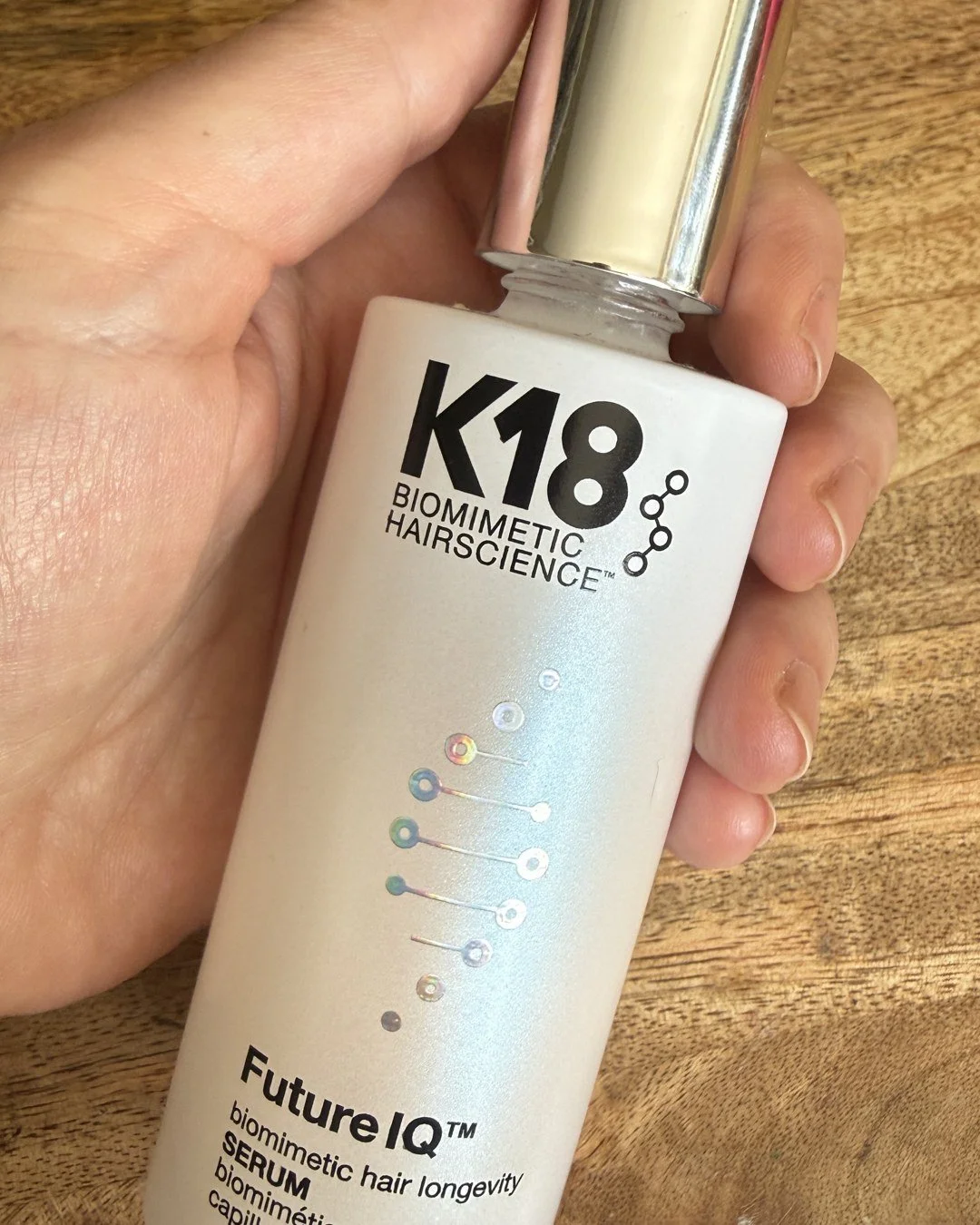
Thinning Hair, Shedding and Early Grays: What’s Helping My Scalp Right Now
Shedding, a wider part, new grays? Here’s why hair thins, what I’ve noticed after six weeks of nightly K18 FutureIQ serum, and how to get fullness now.
Almost every week someone sits in my chair and quietly asks, "Is my hair getting thinner?" Shedding, a wider part and new grays are some of the most common worries I hear. Hair changes over time for everyone, and there's more we can do about it than most people realize.
Why hair thins
Thinning usually comes from a mix of things: genetics, hormones (postpartum, perimenopause and menopause are big ones), stress, illness, nutrition, and simply getting older. As the scalp ages, follicles can weaken, hair grows back finer, and pigment production slows, which is where grays come from.
If your shedding is sudden, comes out in patches, or comes with an itchy or painful scalp, please see your doctor or a dermatologist first. Some causes, like thyroid issues or low iron, are very treatable once they're found.
What I'm trying: K18 FutureIQ Hair Longevity Serum
I've been using K18's new FutureIQ serum every night for the last six weeks, and I wanted to share an honest update. It's a leave-in serum for the scalp that's made to target three things: shedding, early graying, and scalp aging.
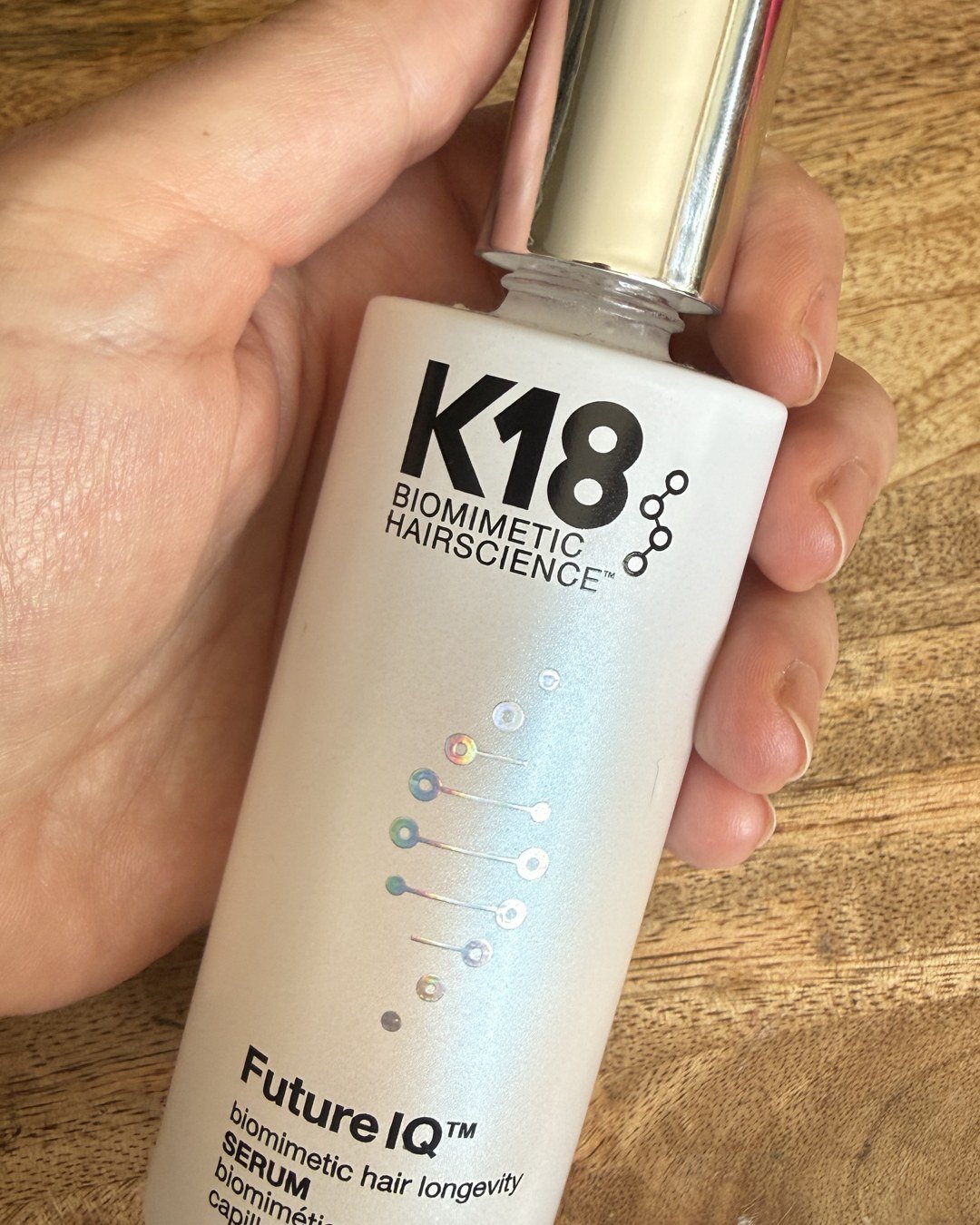
K18 says it works by strengthening the root of the hair and protecting the follicle from everyday wear and tear. In their own 12-week study, the company reports that users kept up to 19,000 more hairs and that 70% had fewer grays by the three-month mark.
My routine: I keep the bottle on my nightstand so I never skip a night. Before bed, I apply four droppers directly to my scalp, then use a scalp massage brush to lightly massage it in and spread it evenly. It works on damp or dry hair, and there's nothing to rinse out.
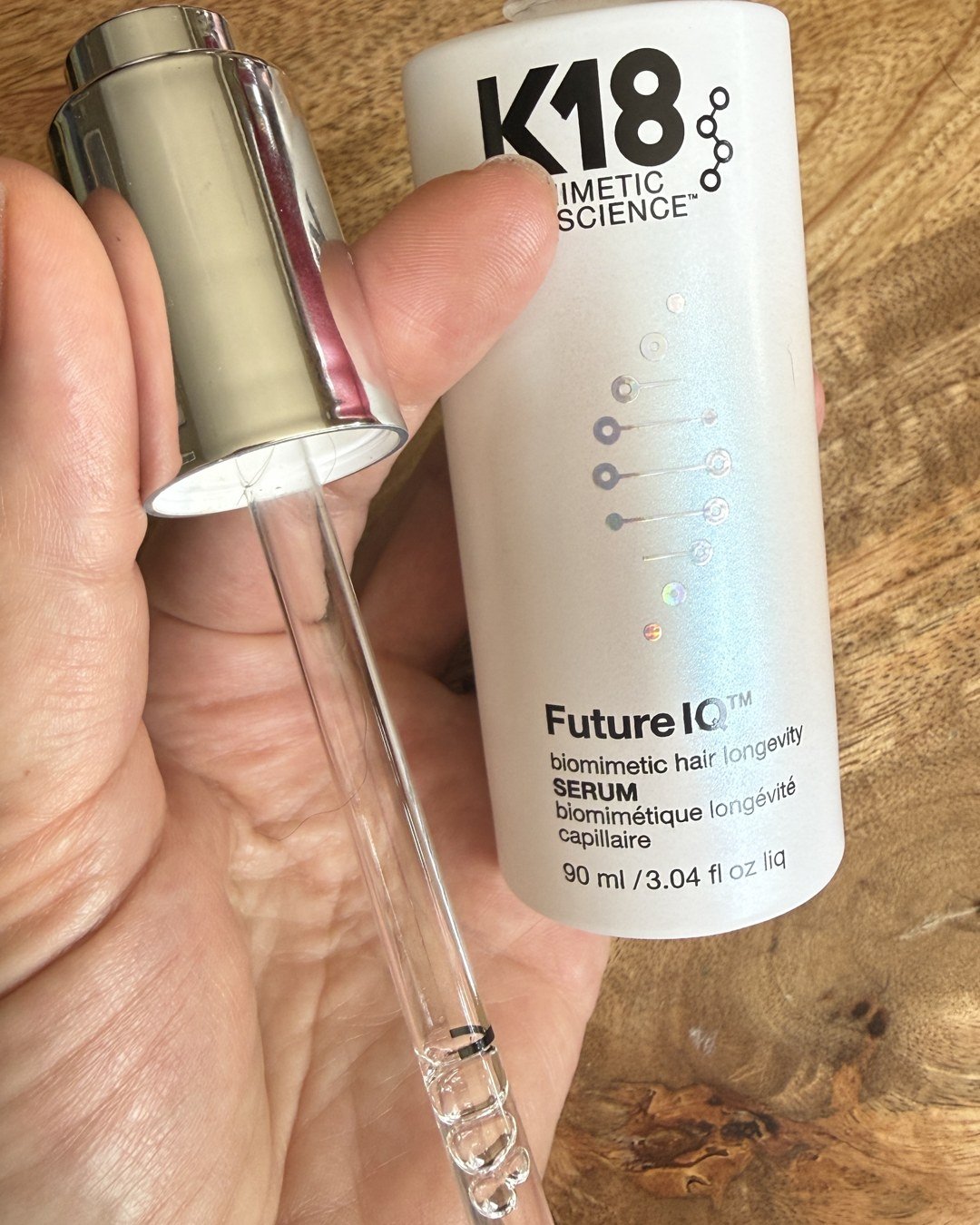
What I've noticed after six weeks: less shedding. I'm finding noticeably less hair in my brush and in the shower. I haven't seen a change in my grays yet, but K18 says full results take about three months, so I'll post another update at the three-month mark.
It is an investment at about $120 for a one-month bottle, so I'd suggest it for anyone who's truly bothered by shedding and is ready to commit to the full three months.
Other ways to support thinning hair
Be gentle: loose styles, a silk pillowcase, and a soft brush used from the ends up.
Turn the heat down on styling tools and use a heat protectant.
Eat enough protein and iron, and ask your doctor before starting supplements.
Get regular trims so thin, damaged ends don't make hair look sparser than it is.
When you want fullness now
Products like FutureIQ work slowly. If you want more volume today, extensions can help, as long as the method is chosen for fine hair. V-light and I-tips use tiny, lightweight bonds that can go right where you're thinnest, and a beaded foundation spreads the weight so your natural hair is protected. The key is a stylist who places them carefully and keeps up with maintenance.
Let's talk about your hair
At your consultation I'll look at your scalp and hair density, talk about what's changed, and recommend the right mix of care and, if you want it, extensions.
Ready to talk? Book a consultation, or call or text 208-841-1090.
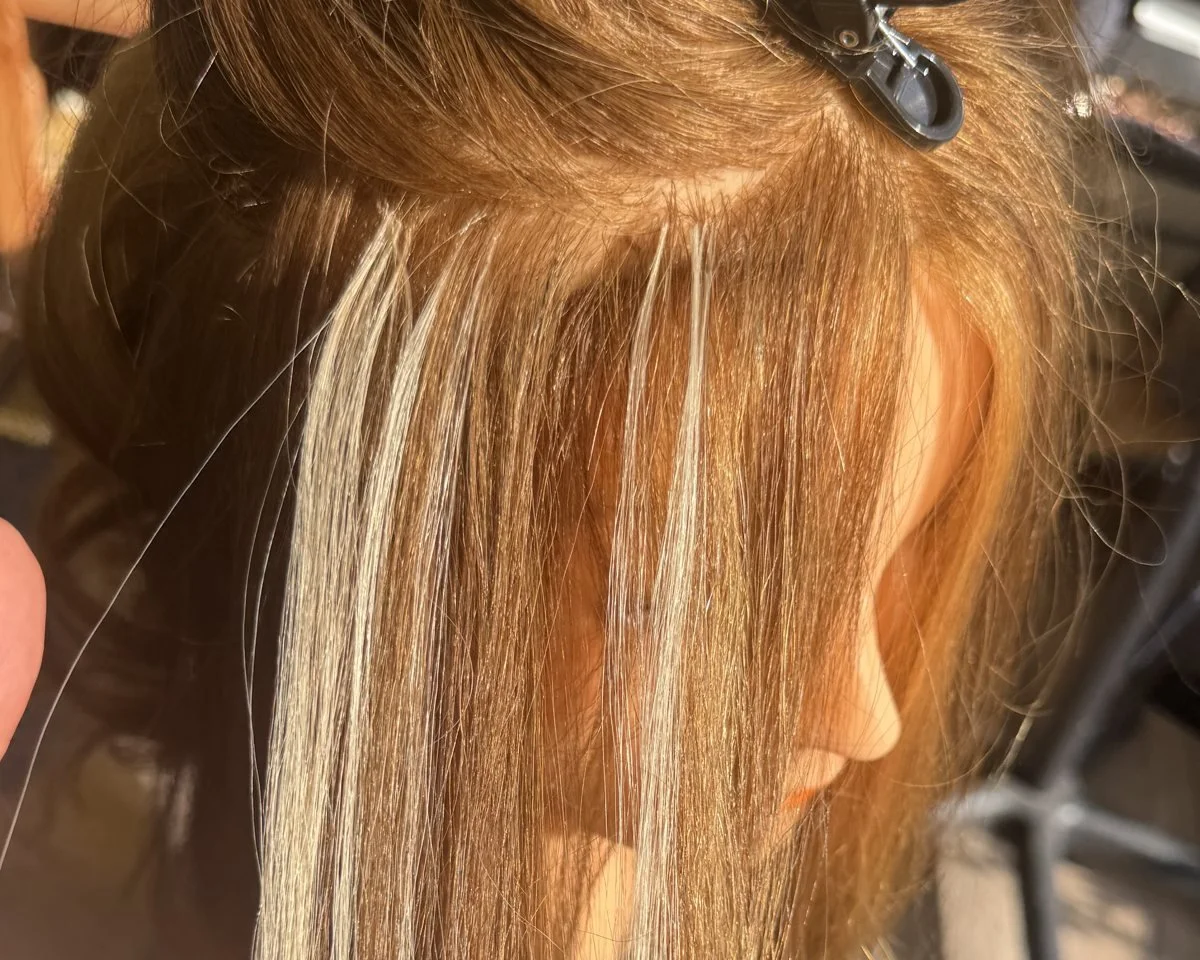
V-Light Hair Extensions in Boise: Tiny Bonds for Fine and Thinning Hair
Fine or thinning hair? V-light extensions use tiny, flat bonds set with a light instead of a hot iron, so you get fullness without weight. Here’s how the method works, how long it lasts and how to care for it.
If your hair is fine, thinning or just doesn't hold much volume, most extension methods can feel like too much. Wefts need enough hair to support a row, and traditional fusion bonds can be bulky. V-light is one of the methods I reach for when a client needs fullness without weight, and I'm now offering it at Fusion Studio.
What is V-light?
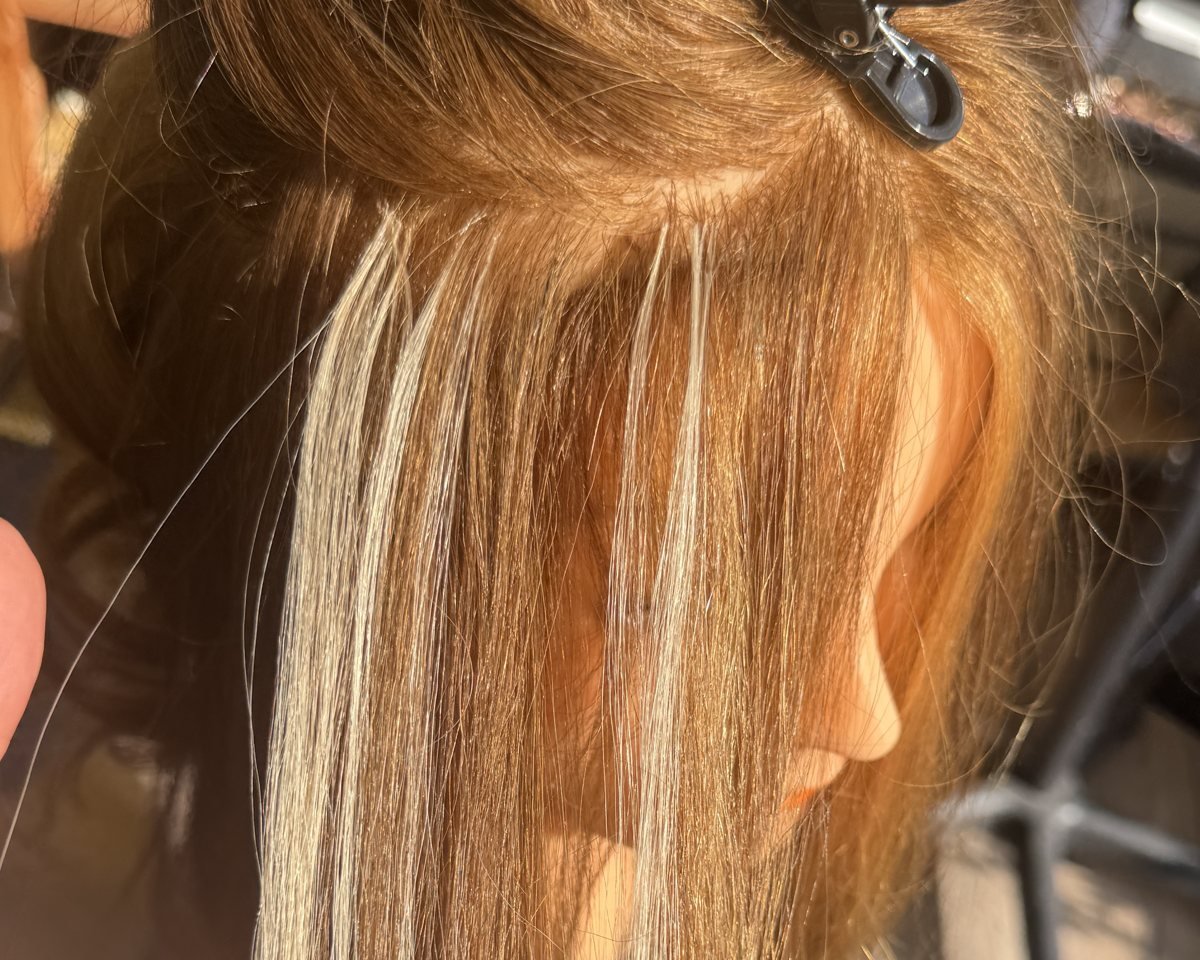
V-light is a strand-by-strand method. Each small extension strand is attached to a tiny section of your natural hair with a clear adhesive, and a small handheld light sets the adhesive in seconds. There's no hot fusion iron during the install, so your own hair isn't exposed to that heat.
Why it works so well for fine and thinning hair
Tiny, flat bonds. The bonds lie close to the scalp and are hard to see, even in fine hair.
Very lightweight. Weight is spread across many small strands instead of one row, so there's less pull on any single area.
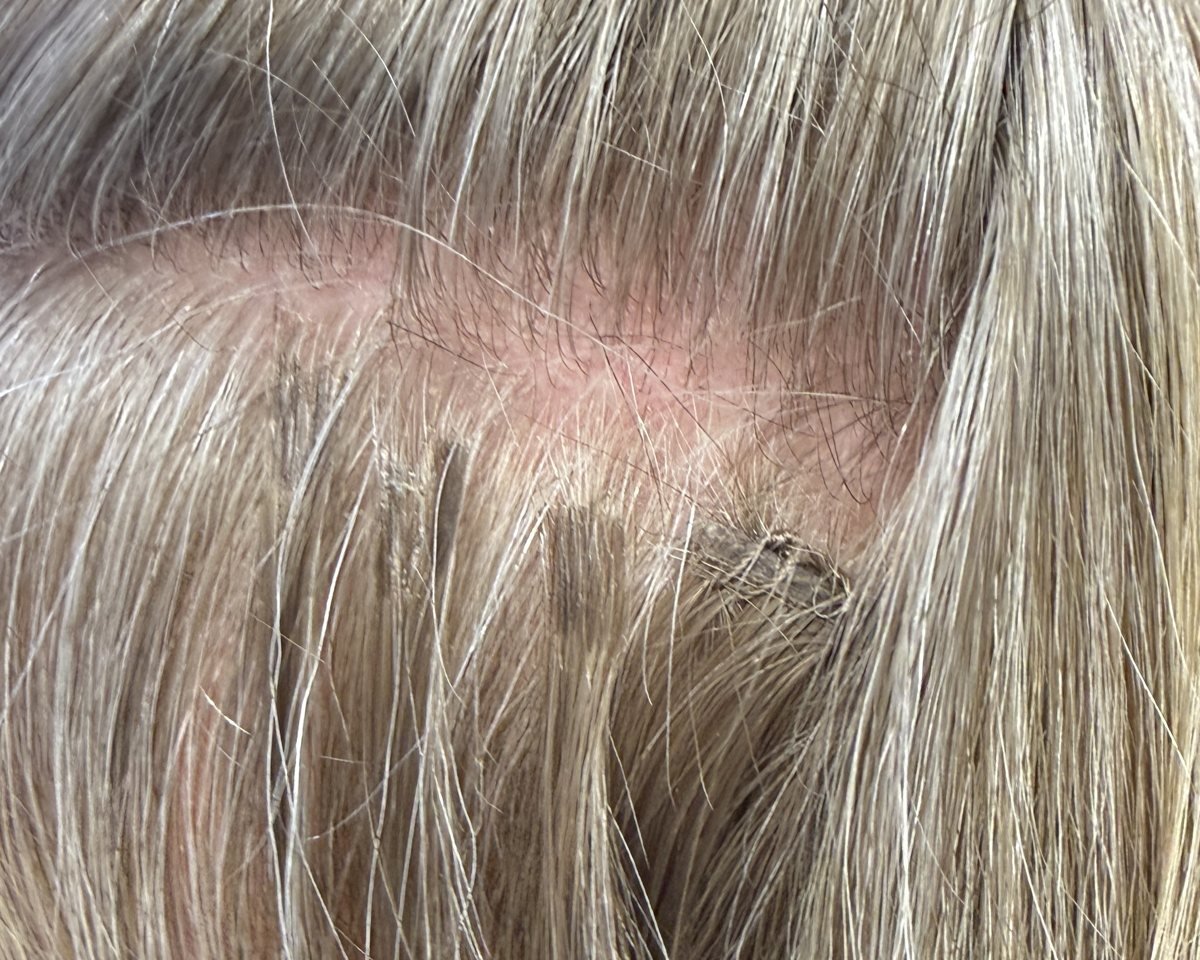
Placement where you need it. I can place strands right around a thinning part, at the crown or near the hairline, where wefts and tape-ins would show.
Custom blending. Strands can add fullness, length or just a few ribbons of color without bleaching your own hair.
What the appointment looks like
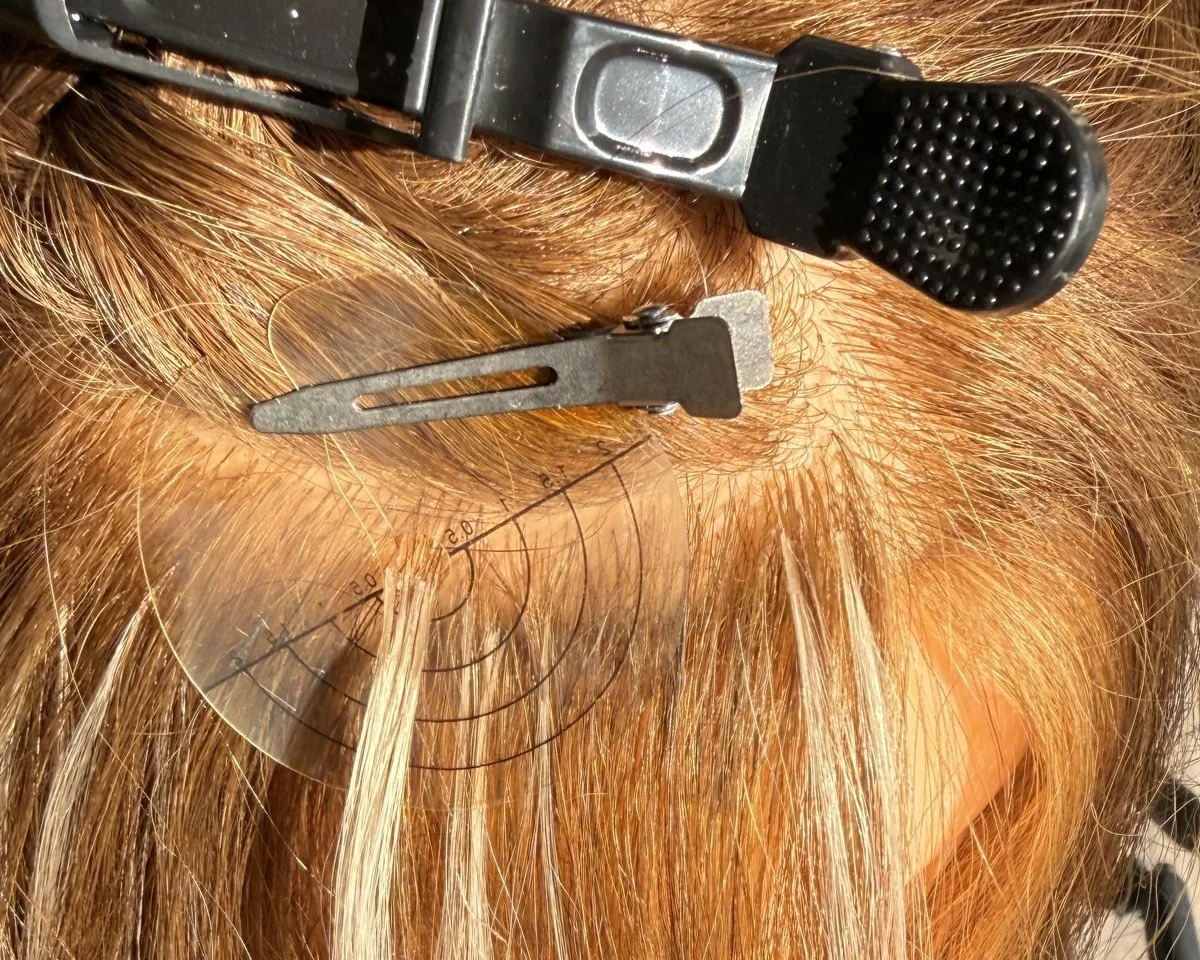
Every V-light service starts with a consultation. I match your color, check the health and density of your hair, and talk about your goals. On install day, I work in small, precise partings. I use a scalp shield to isolate exactly the natural hair I'm working with and to keep any adhesive off your scalp. Then each strand is applied and set with the light.
How long does V-light last?
Plan on maintenance every 4 to 6 weeks. Because the bonds sit so close to the scalp, they need to be moved up as your natural hair grows so they stay comfortable and hidden. How long your strands last overall depends on your hair, your routine and how well you care for them.
Removal is gentle. I either use a remover solution, or warm the adhesive with a heat tool until it softens and the strand slides right off. No pulling and no cutting.
Caring for V-light extensions
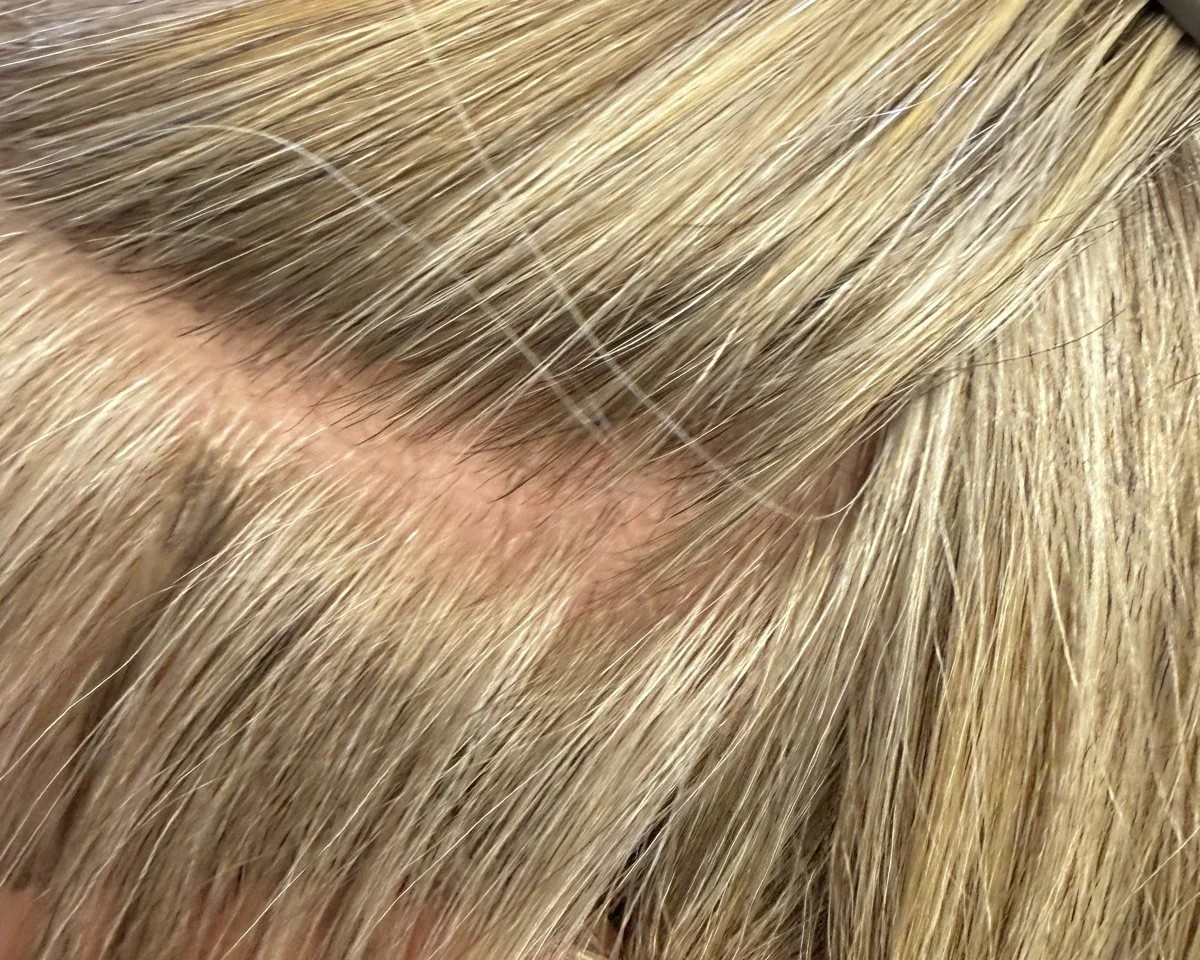
Keep hot tools away from the bonds. Flat irons, curling irons and hot brushes shouldn't be used near the scalp with V-light, because heat softens the adhesive. Style your lengths and keep heat at least a couple of inches from the roots.
Use sulfate-free shampoo and keep heavy conditioner and oils off the bonds.
Brush gently from the ends up, holding the hair near the roots.
Dry the bonds fully, and sleep with your hair in a loose braid or on a silk pillowcase.
Is V-light right for you?
V-light is a great fit if your hair is fine or thinning, you want subtle volume around your part or crown, or you want color without chemicals. If you want a lot of length and thickness, hand-tied or hybrid wefts may suit you better, and some clients do best with a combination of methods. We'll go over all of this at your consultation, and I'll give you a custom quote.
Ready to see if V-light is right for you? Book a consultation, or call or text 208-841-1090.
Hand-Tied vs. Hybrid Weft Extensions: What They Are and How to Choose
If you’ve been researching hair extensions, you’ve probably seen the words “hand-tied weft” everywhere. It’s one of the most requested methods in my chair, and for good reason. Wefts add serious length and fullness while staying comfortable and nearly invisible. But the word “weft” now covers several different products, and knowing the difference helps you choose the right one for your hair.
Hand-tied, machine, and hybrid wefts
A weft is a long, narrow curtain of hair joined together at the top along a thin seam. Instead of adding hair strand by strand, a weft adds a whole row of hair at once, which is why it’s so good for volume.
Hand-tied wefts were the original gold standard for a flat, natural install. Small bundles of hair were folded over and knotted, or braided, onto a thin thread track by hand. They lay flat and moved beautifully, but the track couldn’t be cut without unraveling, so every row had to be folded or sealed with glue to finish it.
Machine wefts are sewn together by machine. They hold lots of hair, but the seam is thicker. Like hand-tied wefts, the hair is folded over at the top before it’s stitched.
That fold is a problem both older styles share. It leaves a little “mustache” of short return hair along the top of the weft that is useless at best and itchy and uncomfortable at worst.
Hybrid wefts are the new standard, and they’re what many people mean when they say “hand-tied” today, even though they aren’t hand tied anymore. They’re machine wefted and gathered into a very thin, fine, flexible seam. Here’s why I love them:
Cut to fit, with no unraveling. The seam can be cut to any width, so there’s no folding or glue needed to finish a row.
No return hair. No mustache and no itch, just a clean, flat seam.
No shedding. The seam is so secure the hair stays put, so you keep loads of beautiful, long hair.
Built to last. The seam doesn’t swell, discolor, dry out, or crack.
Reusable. Hybrid wefts can be moved up and reinstalled many times, and usually only need to be replaced about once a year.
How wefts are installed
In my studio, wefts go in with a beaded foundation and thread. There’s no glue and no heat on your hair.
I create a row of tiny beads along a clean horizontal section of your hair, color matched to your roots.
The weft is temporarily clipped to the hair and bead structure, then checked for placement and anything that might get in the way.
The weft is sewn onto the beaded structure along the row, keeping it flat and secure while letting your natural hair keep its natural growth pattern.
Your own hair falls over the row and hides it completely.
Most clients wear one to three rows, depending on how much volume and length they want. Because nothing is glued, the same hair can be moved up and reused at maintenance appointments.
Your weft options at a glance
Hand-tied: hair folded over and knotted or braided by hand onto a thin track. Flat and flexible, but it has return hair along the top and unravels if it’s cut. The original flat install, now largely replaced by hybrid.
Machine / volume: hair folded over and machine-sewn, with return hair. A thicker seam with lots of hair per row. Best for thick hair and maximum fullness.
Hybrid (also called genius or infinity): machine wefted and gathered into a very thin, fine seam with no return hair. Thin, flexible, and secure, with no shedding and no itch, and it can be cut to any width. The best fit for most clients.
No-sew / butterfly style: a weft designed to open so you can wash and dry underneath. Lies flat and is quick to install.
The hybrid infinity wefts I use are my favorite for most clients. They give you the thin, flat, comfortable feel of hand-tied with the freedom to cut the weft to fit your head exactly, so there’s less bulk and a more seamless blend.
The professional brands I work with
I only use professional, salon-grade extension hair, the kind sold to licensed stylists rather than off the shelf. Each brand has its own strengths, and I choose based on your hair, your color, and your budget.
BELLAMI Professional: offers the Volume Weft for maximum fullness, the Flex Weft in two versions, and the Infinity Weft, a lightweight hybrid weft with an ultra-slim seam.
Babe Hair Extensions: known for the Ideal Hybrid Weft, which Babe says can be cut to any size without unraveling. They also carry hand-tied and machine wefts.
AQUA Hair Extensions: thin, flexible wefts in 14”, 18”, and 22” and more than 40 shades, including rooted and balayage blends. AQUA also makes the Q-Weft and a no-sew butterfly weft.
Perfect Locks: carries hand-tied, hybrid, and machine wefts, plus wavy textures.
Doctored Locks: a professional supplier carrying weft lines like Bohyme Luxe and Classic in 14” to 22”, in textures from straight to body wave, and the lighter-weight Bliss line.
Cinderella Hair: makes the Better Than A Weft, designed to be cut to size, lie flat, and install quickly, in 14”, 18”, and 22”.
Bombshell Extension Co.: wefts in lengths from 14” to 24” and more than 40 colors, including dimensional, rooted, and ombre shades.
Whatever the brand, I color and texture match in person, and every method is available in straight, wavy, and curly.
Caring for your wefts
Move-ups every 5 to 7 weeks. As your hair grows, I slide the bead row back up close to the scalp. Maintenance is $150 per hour.
Gentle products. Sulfate-free shampoo and conditioner keep extension hair soft and help it last.
Untangle starting mid shaft to ends with a loop or extension brush, securing the hair near the row to prevent pulling and tugging.
Sleep in a loose braid or silk bonnet to prevent tangling.
With good care, hybrid wefts can be reinstalled at every move-up and usually only need to be replaced about once a year.
Are wefts right for you?
Wefts are a great fit if you want noticeable volume and length with a comfortable, seamless install. If your hair is very sparse, or you mainly need help at the hairline or crown, another method like fusion or V-light may be a better match. Often, the best result is a combination of methods.
That’s exactly what your consultation is for. We’ll look at your hair together, match your color and texture, and decide which weft (or method) will look most natural on you. Consultations are free. Request yours on my Consultation page, or call or text me at 208.841.1090.
Studio Menus
You can book a complimentary consultation by calling or texting 208.841.1090.

Studio Communications
Since Julia has started the cosmetology apprenticship program I have been creating documents to track, and record the progress that we are making. There is actually a lot to keep track of. I have always been an organizer so for me this is really fun. I enjoy transmitting information to her that I personally repeat over and over again. The process is simple. It is the implementation, the daily grind of this routine that is the challenge. So I figured that if I could make that a little more enjoyable then it would be easier to learn. Let me know what you think about the samples. Perhaps you forsee some possibilities for lists in your life. At the salon we have these sheets laminated and placed in the areas where we track the repetition of these tasks.


Hair Extension Menus
I have been working on some new graphics for the salon. These are a simple way to better communicate what is available and what the cost associated with it will be. I also made a sample menu for my daughter, Julia, who will be starting the apprentice program with me in October of this year. I am so excited for her!

Hair Extensions Simplified

Current Fusion Studio Salon Menu

New studio logo. Created by Jennifer Bridges.

Julia’s first spa menu. She wants to focus on affordable and straightforward treatments where she feels confident in providing a service. I know that facials and glossers will be a fantastic choice.
Julia will be accepting clients after the beginning of November 2025. Book your appointments now. I know she will be popular and very caring.
Fusion Studio
I am settled into my new studio. I love it there so much! I have 2 treatment rooms, an office, a reception area, a kitchen and a bunch of plants. I have been eager to go to work most days of the week.
I currently have both treatment rooms set up for hair extension application and removal. The office is being used for art creation and daydreaming. The reception area houses an array of hair extension specific products for my clients to maintain their investment. I also have an incredible selection of scalp and nutritive hair care products to help maintain the hair that you have and keep it in good shape.
I have hung my art up on the walls. I have a cabinet full of hair extensions and another one full of hair color possibilities. I am ready to help you with any hair extension projects that you currently have or desire to have.
Currently offering a full hair extension menu of both installation and maintenance of these types of hair extensions: Fusion, Hybrid Weft, Beaded Row Weft, Tape-In, Beaded Single Strand, Combline Nano-Extensions. Within these options are a possibility of combination of any of these styles.


Training
I am very excited to bring a new installation service to my customers. I am traveling to LA at the beginning of February to take the Combline class. Combline offers a “nano” installation. The technique is specifically designed to install hair in in areas that are very visible, like the perimeter of the hairline and the crown of the head.

These areas are a problem to disguise for clients that are concerned about thinning hair. Normally a client would have to wear a topper, a ton of dry shampoo and or hairspray to fluff the hair up. Or a client might use a scalp powder to disguise the shine and visibility of the scalp.
The compline technique will allow clients to double or triple the hair in the area without chunky or heavy bonds.
The other incredible feature of these delicate extensions is that they are designed to fall out on their own. Anyone who has had extensions can attest that removal is a costly and irritating process which puts natural hair in a vulnerable state. The Combline extensions are designed to shed on their own. This is similar to the principle of eyelash extensions. After a period of 4-6 weeks the majority of the COmbline extensions will have shed away from the natural hair.
Another incredible thing about these Combline extensions is that any hair can be used with this installation process. I really love this! We can use a clients old hair or we can use any new hair in their specific color, texture and length that they desire. This goes a long way in the ability to accurately match and blend the extensions.
I will let you know more about this incredible technique when I learn in just a couple weeks. I will also be putting in some incredible museum time while I am in LA so I will get lots of artistic inspiration.
Update: I completed the training. Finished my certification with the company a few weeks after the class ended.
I have been installing the nano hair extensions in clients and for the clients with the super fine thin hair it has been a really exciting possibility. Still learning and experimenting.


Are your hair growth products working?

When you invest time and money into a product line that promotes hair growth you typically have to just sit back and wait to see if there are any results. Are these things working? The pills, the shampoos, the serums, the thickeners. All you have to go by are the testimonials that are on the websites of the products themselves.
Fusion studios is offering a detailed scalp analysis appointment to determine if the time and money that you are investing into these products are actually working. What would this appointment include?
The appointments are set up as a pair. The initial appointment would include a detailed intake of the current topical products and or supplements that you are taking. In the treatment room a detailed scalp analysis is conducted. This analysis includes a inspection of every inch of your scalp, section by section, talking you through any and all features that we believe to be of importance. This would include analysis and location of moles, angiomas, scalp conditions, and density measurements. In a few specific areas of concern we will take a microscopic exam of the hair follicles and the hair coming of them. These images allow us to accurately measure and determine the effectiveness of the products in use. The analysis process is deeply relaxing and enjoyable.

After the scalp analysis a separate service of scalp micro needling and topical treatment to the scalp are available if requested. The micro needling service is relaxing, not painful. The micro needles do not puncture or bruise the skin. The process stimulates circulation. The scalp treatment is finished with head and neck lymphatic drainage.
The follow up scalp analysis appointment is included in the cost of the initial appointment. During this appointment we will again perform a therapeutic and detailed scalp analysis. Imaging of the previously measured scalp and follicles will again be charted.
Afterwards there will be a side by side comparison of the measurements and imaging taken during both appointments These will be used to make further recommendations about the effectiveness versus the cost of the current program that you are on.
The cost for the pair of scalp analysis appointments is $250. Additional scalp treatment services, including micro needling are $100-150.
Products related to scalp care, growth and exfoliation will be available for purchase at Fusion Studios. All products are very affordable, generally being around $20 per item.
Book an appointment today by contacting 208.841.1090
Moving
I am thrilled to announce that I am moving into my own personal 1000 sq ft salon space. I will continue to do all types of hair extensions. In addition I will be adding a few services.
I have been studying and training for a few years in facial cupping and lymphatic drainage. I will have a facial treatment room and offer a facial cupping service combined with gua sha and lymphatic massage.
I am hoping to be moved in and working in the space by the second week of December. I will add a new treatment menu that will start in January.


Hybrid Hair extensions
Why choose just one method of installation when you can combine the best of both worlds? I have been mixing up my client’s application methods lately. You can mix Hand tied weft and fusion application or machine tied weft and beaded application. I have one client who combines both beaded and fusion methods.
Why would you combine methods? Each method offers its’ own advantages. The hand tied and machine tied wefts add a lot of hair in a short amount of time, but you may find that you still want some noticiable highlights. Or you might want some more hair around your hairline perimeter which needs to be fairly invisible, so fusion could be the answer in that particular area.
Fusion extensions are not recommended to be reused. But if you place a few highlight pieces of fusion on your hand tied weft they will never have to be removed from that hair. Those piece will be moved up when the weft is moved up. You can dream big dreams when it comes to hair replacement. There is a method that is just perfect for you.

Sunscreen
I am slightly obsessed with sunscreen. I have been actively applying sunscreen to my face since I was 13 years old. It all started with Oil of Olay face lotion that had an SPF 15.
My obsession increased after I had children. Pregnancy caused melasma on my face, brownish splotches, which I hated. I was so confused why I was having these spots when I had been so diligent about protecting my skin from the sun. Old sun damage did contribute to the blotchiness on my skin, but I believe hormones were the primary cause of the brown spots. Fast forward 13 years and tons of beauty treatments (Botox, IPL, Microdermabrasion, Pico wave laser, skin peels) and I really do feel great about my skin. The brown spots have completely faded and my skin is glowing.
So naturally I am wanting to keep my skin looking fabulous and that is where sunscreen comes in. Not only do I wear an SPF 40 daily (Origins, A perfect world is my current favorite) but I also wear a hat when out in the direct sun.
My skin inspirations are Nicole Kidman and Cate Blanchett. They have such beautiful, naturally glowing skin. I know that they take great care of their skin by protecting it from the sun and probably rubbing thousands of dollars of special creams on their faces.
My other new skin obsession is getting a Gua Shau facial. This facial helps to move all the lymph around in your system. It also massages lovely oils into your skin, lifts and improves the tone of your skin and deeply relaxes me. I adore my facialist, Angela S and if you want her number I will gladly give it to you.

How much do Hair extensions cost?
There are a few different methods to choose from so I will just cover the most popular current types. I use a few different brands depending on the method of installation. Any of these methods can be combined. The cost varies depending on the length, color, texture and amount of hair needed.
Hand Tied Weft $800-1800
Fusion $250-1600
Volume or Machine Tied Weft $800-2000
Tape In $250-1000
Beaded $250-1000

Hand Tied Weft
This is an invisible installation using 2 pieces of hand tied weft.
Volume Weft Installation
The volume weft installation has been a tremendous way to add a lot of hair. For your money this is the best way to add as much hair as you can. The volume weft comes with three rows sewn together. I like to take one of the rows apart from the other two and perform an invisible installation with the double orw on the bottom and the single row on top. This allows the beads to be concealed for any up or down styling. It also adds the maximum amount of hair. The volume or machine tied weft has a bit thicker of a seam even deconstructed to one. This makes it a bit more durable so this hair is very likely to last for a year without shedding. The weft can also be cut anywhere and will not unravel. You cannot do this with a hand tied weft. The hand tied weft can only be folded over.
The volume weft is also called a machine tied weft. You get more than double the amount of hair that comes in the hand tied weft!
Client requirements: You must have fairly dense hair. This installation is best for people who want to add length and have medium to thick density hair.
It looks like this weft might be too light compared to the roots.

But when attached and the natural hair is dropped down there is a beautiful blend. This one piece of weft is a thousand highlights.

Invisible Seamless Weft installation
This installation is brand new to the world and it is amazing for fine hair. The difference in this installation is the way the weft wraps around and under the beads. It is ideal for a client with fine or thin hair who would like to experiment with a volume installation. This is done only with hand tied wefts. It is the perfect combination of the delicacy of the hand tied weft and the invisibility of a multiple weft installation. Check out the pictures below. I have had a lot of fun installing this configuration.

Wig customization
Wig customization is now another service that I am happy to offer to the public. I have been doing research and training in wig working for a couple of years now and I have finally had enough private priatve clients that I can move forward to offering the general public these services. Wig customization takes time and a lot of special knowledge. The skills that I have acquired over the last 16 years in hair extensions have really paid off. Building a relationship with the suppliers and getting to know the products is an ongoing process and hopefully always will be. Learning color techniques that are specific to human extension hair is crucial. Hair is considered a fabric. Some fabrics are fine and silky and then there are other fabrics, like jeans. Well, hair extensions are their own special kind of fabric and it takes a long time experimenting to learn the nuances of what works and what doesn’t work. Cutting and styling the wig are the other crucial elements that can make the wig feel like your own.
While I am busy setting up my online shop I can still take custom orders. I am currently dedicating 2 days a week specifically to wig working and hoping to expand that.

Hand Tied Weft
I have learned a few new tricks and now I can confidently say that I love installing hand tied weft extensions. I can make them invisible by installing one weft below and one above. I can blend them seamlessly by custom coloring. I can match the bead to the density and color of your hair and I can install quickly and accurately which will keep your hair feeling perfect for longer. I have been taking online classes over the last 12 months. I became certified in another brand and have dedicated myself to online learning every month over the last year. There are new options; new threads, new textures, new density, new installation techniques. Everything has gotten so much better.
Thank you to all of my current clients who allow me to experiment on your hair while learning what works best over time. If it weren’t for my amazing clients I wouldn’t know what I know. I can learn online as much as I want but actually practicing these techniques on real hair with different density issues is how I really learn.
I have included a few examples of my current work. Enjoy!

Hand tied weft

Hand tied weft

Machine tied weft